Skyrim Basic Linear Quest
This is a sample of a simple linear quest designed as if for Skyrim. Includes player-facing quest text, branching dialogue, and more.
For: Portfolio Sample
Type: Mission
Genre: Fantasy / Action-Adventure (Single-Player RPG)
Roles: Writer
This script sample was written as an example of a simple, linear quest in a game many are familiar with — Skyrim. This sample includes:
All the player-facing quest text
Multiple branching dialogue trees for encounters with NPCs
Voice direction notes
Implementation notes for implementing the quest in-game
Deadlands
A pilot for an hour-longs sci-fi tv show that poses the question: “Does mortality make us human?”. Explores it through the lens of a far-future gold rush on a haunted world where spirits roam and fortune-seekers come looking for the secrets to immortality.
For: Written on Spec
Type: TV Pilot (Hour-Long)
Genre: Sci-Fi
Roles: Writer
This sci-fi pilot takes inspiration from Aliens and Indiana Jones to tell a story set on a haunted world in the far, far future. It was a finalist in the 2021 Screencraft Sci-Fi/Fantasy Contest.
Logline: On a world haunted by the ghosts of our deceased, explorers from across the galaxy have gathered to try and strike it rich. In the midst of this gold rush, a young woman endeavors to answer the question that her father dedicated - and lost - his life to: why do our souls come here when we die?
EXCERPTS
-
The opening scene of the pilot.
Fantasy Adventure Script & Outline
This is a script and outline sample for a hypothetical single-player fantasy RPG in which the player is accompanied by NPC companions.
For: Portfolio Sample
Type: Mission
Genre: Fantasy / Action-Adventure (Single-Player RPG)
Roles: Writer
This script sample was written for a hypothetical fantasy-adventure RPG in which the player is accompanied by NPC companions. This sample includes:
An overview of the premise
The asset breakdown of the Characters, Locations, and Props featured in the outline
A script outline that breaks every scene down into cinematic and gameplay sections
A script excerpt featuring the non-interactive dialogue that occurs across both gameplay moments and cinematics.
Fantasy NPC Description & Dialogue
A sample description and simple dialogue tree for a basic Fantasy NPC that could be found in Skyrim.
For: Portfolio Sample
Type: NPC Description & Dialogue
Genre: Fantasy (Open World RPG)
Roles: Writer
This sample introduces a hypothetical minor NPC to the world of Skyrim. The sample contains:
A description of the NPC
A schedule that defines where and when the NPC can be found
Greetings & farewells – barks the NPC might say at the start / end of conversations
A small dialogue tree – for a simple conversation with this NPC
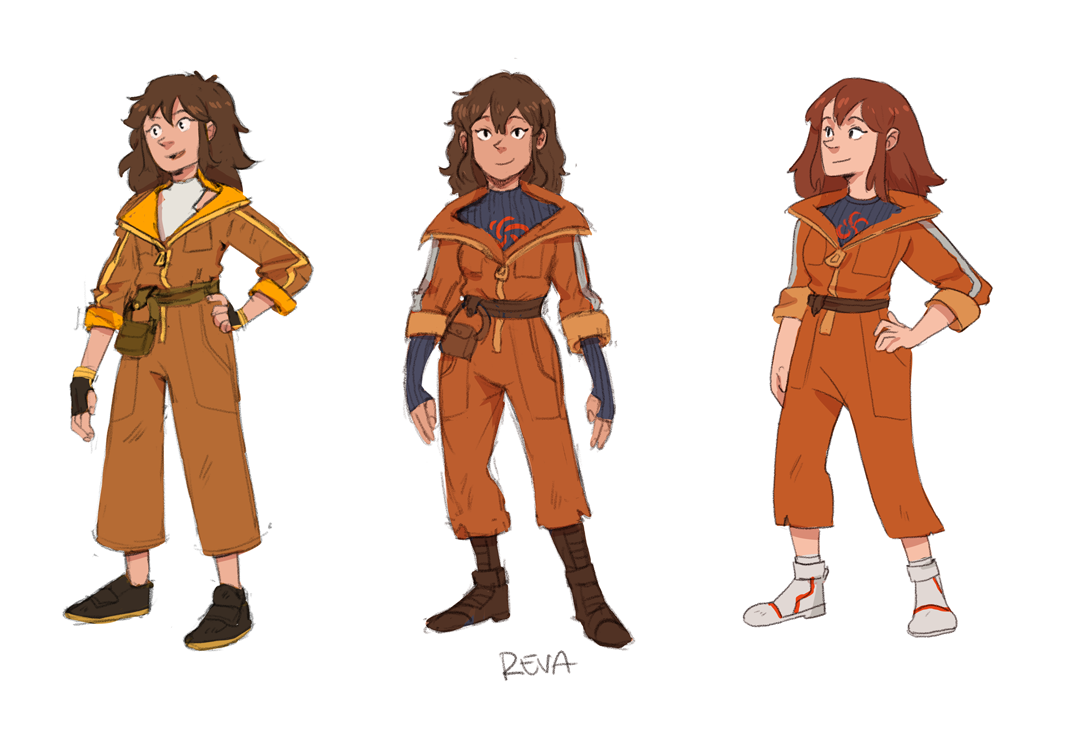
YA Fantasy Character Design
An in-depth breakdown of the character design work that went into the creation of Reva, the titular character of a YA fantasy graphic novel I created with Anne Marcano.
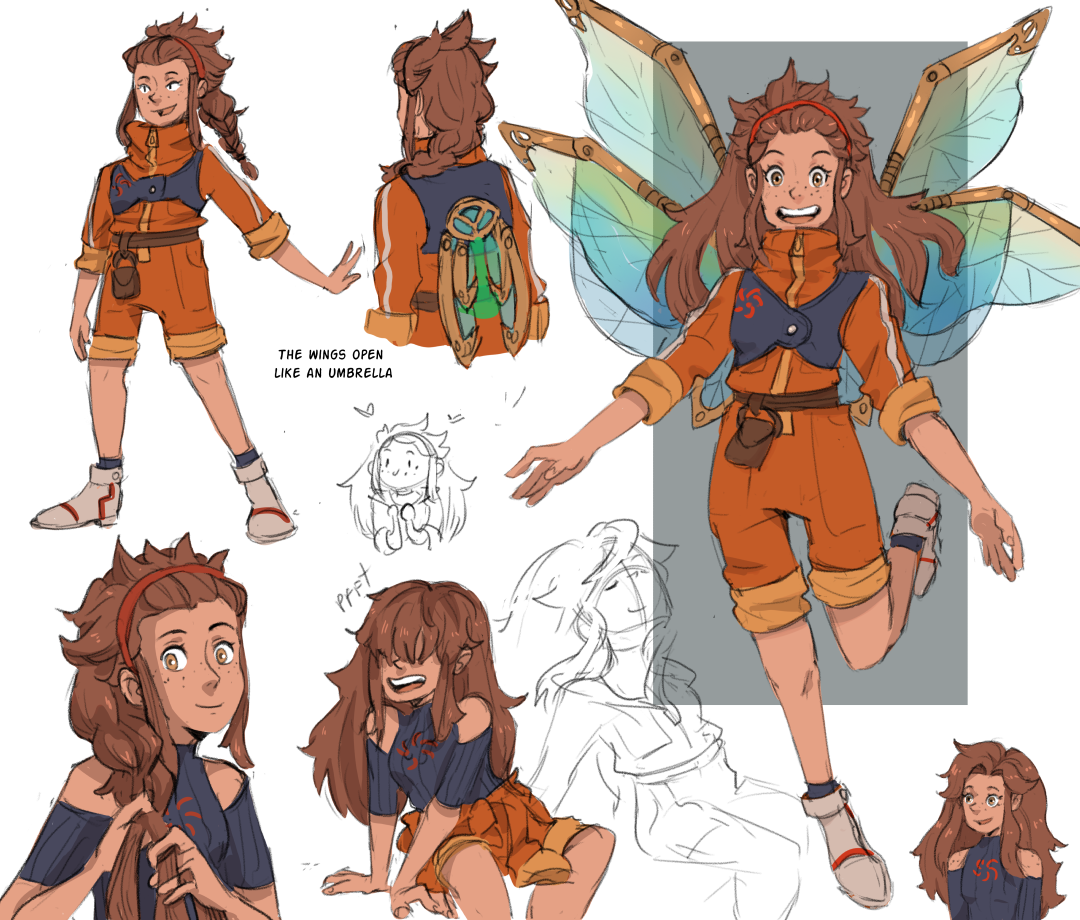
For: Graphic Novel (proposed)
Type: Character Design
Genre: Fantasy
Roles: Writer
“Reva & The Four Skies” is a young-adult / middle-grade fantasy adventure graphic novel about friendship & self-acceptance set in a world of floating islands and great rivers of air currents. I developed this pitch with the artist Anne Marcano. Below, I’ll highlight the work we did together to develop the design for the titular main character, Reva.
The Character
The First Designs
Reva is the core of the ensemble cast of main characters in The Four Skies. To help guide her design, I provided Anne with a detailed description of the character.
Reva (15) grew up on a small island in the South Sky that’s always been little more than a small rest stop for passing airships. As a result, she’s never seen much of the world — though visiting vessels have turned her into quite the dreamer, envious of all the travelers who pass through her home. Stuck at home, Reva instead finds her own freedom in flight, using her glider to ride winds across the island.
You might call her reckless, but the truth is Reva is a natural. She’s more at home in the air than on her own two feet. She’s deeply passionate about flight with a cheerful demeanor and a natural enthusiasm and curiosity for the world around her — to the point of naivety.
She’s often on call to help in her mother’s skydock, and wears a messy jumpsuit (or perhaps overalls) that give her a sort of “worker / engineer” look. I imagine her as lightly tanned, from her time outdoors, with medium-length hair that she can let down when flying and keep tied up in a messy bundle, like it’s an unimportant detail to her.
She was meant to be lightly inspired by Amelia Earheart.
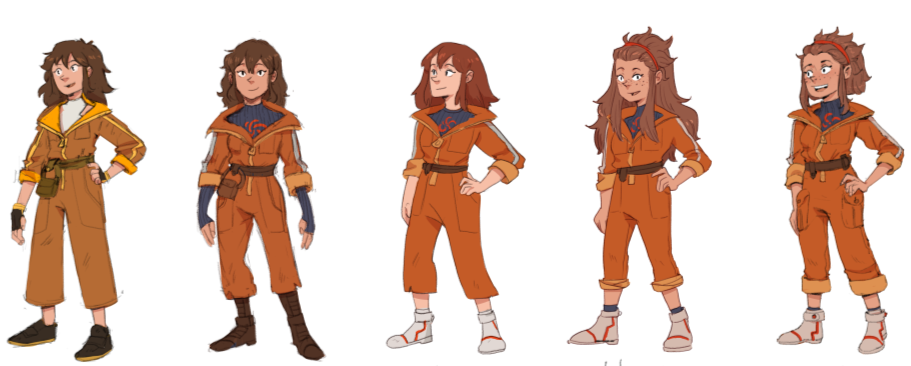
Here are some of the earliest designs Anne drew for the character of Reva.
We landed pretty quickly on the flightsuit look and began experimenting with various details:
Gloves
Shoes & Boots
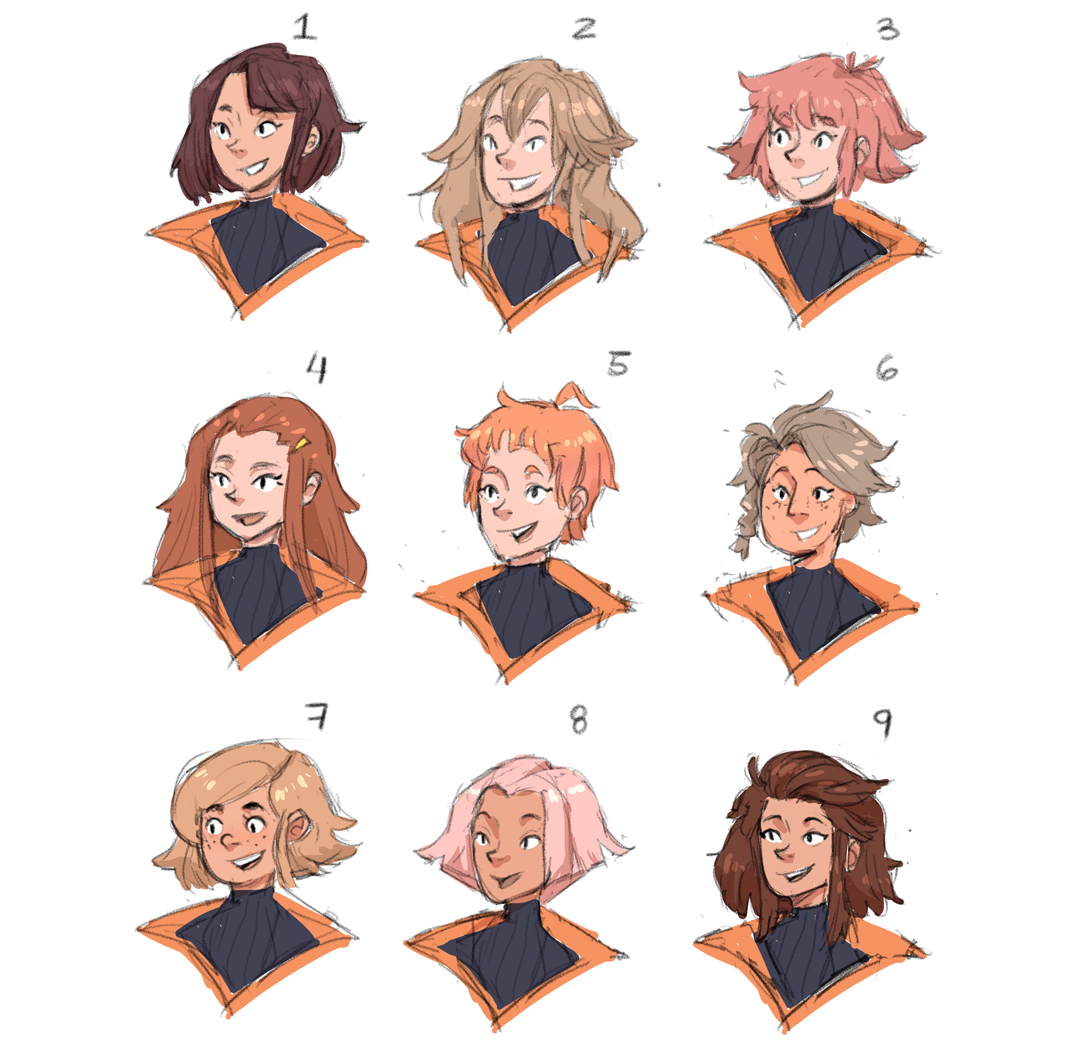
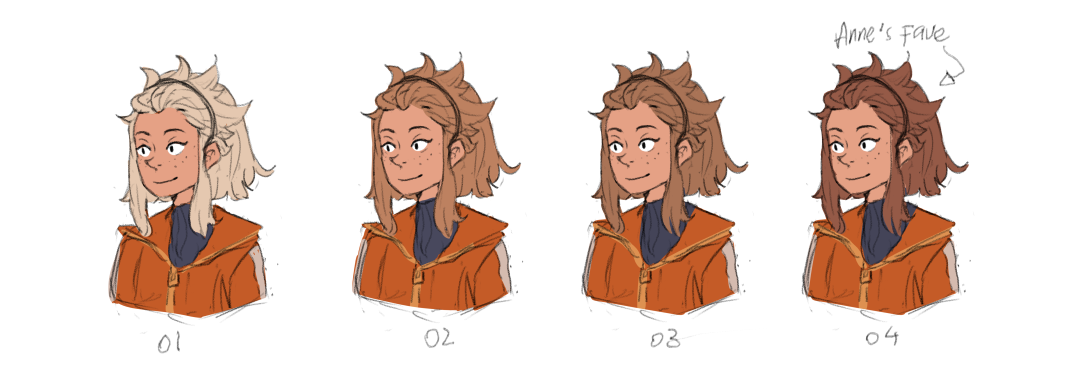
Face-Shape & Hairstyle
Notes & Iteration
While we really liked the initial designs, we felt there was still an opportunity to better express Reva’s personality, in particular through her face, eyes, and hair. Satisfied with the jumpsuit look we landed on, we explored many different designs. Ultimately, every choice we made was informed by a few core pillars of who Reva was meant to be:
Tanned — She’s an outdoor kid, so a more tanned look would suit the character better.
Balanced Face Shape — Somewhere in between the angular and rounded look we initially explored, we felt the look we landed on gave her the best balance of looking energetic, while still remaining young, cheerful, and bright.
Hair Style — Anne brought a lot to the table here, with tons of different hairstyles to help us see how each style changed her demeanor. We wanted something that would flow well in the wind and a semi mid-length cut that could be wild and free in the air, or corralled into a semblance of tidiness as needed.
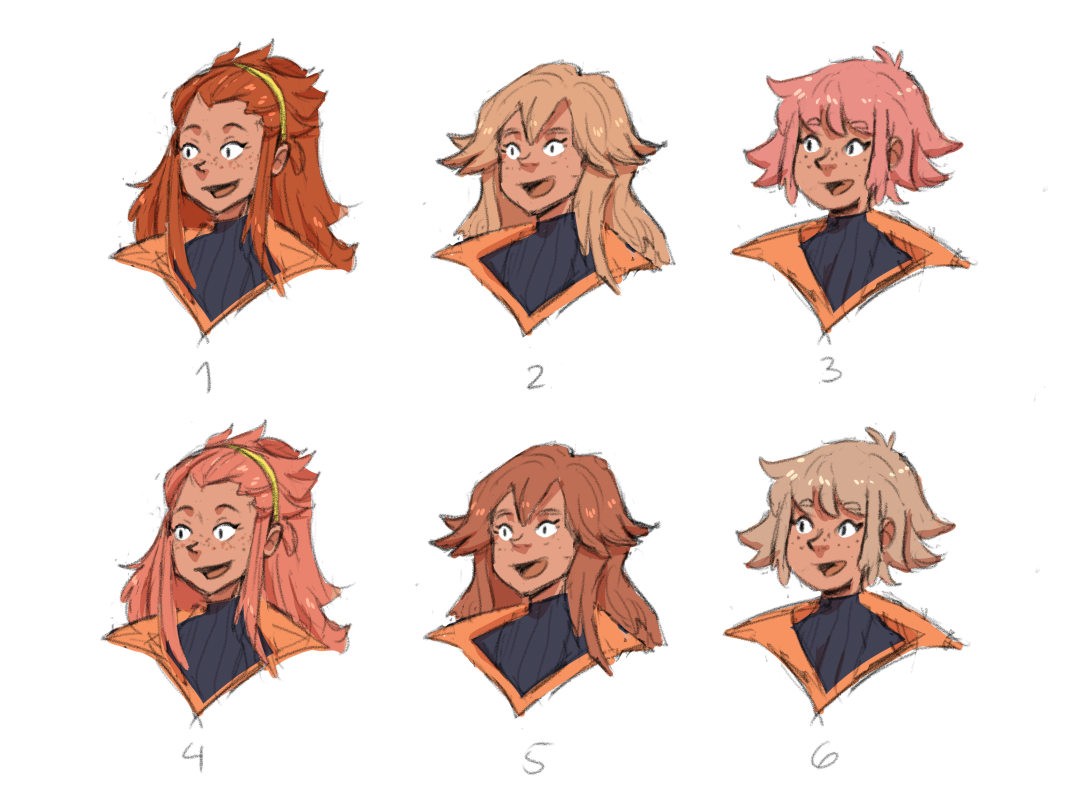
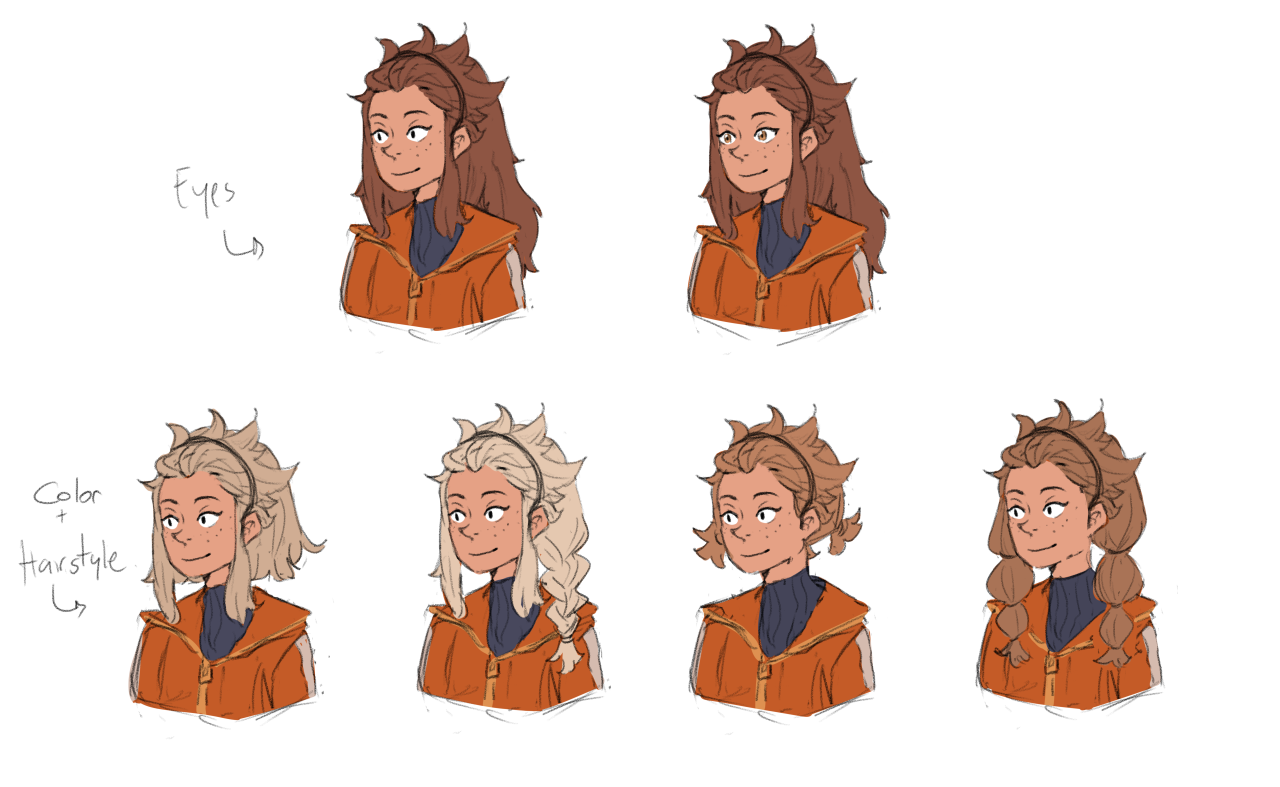
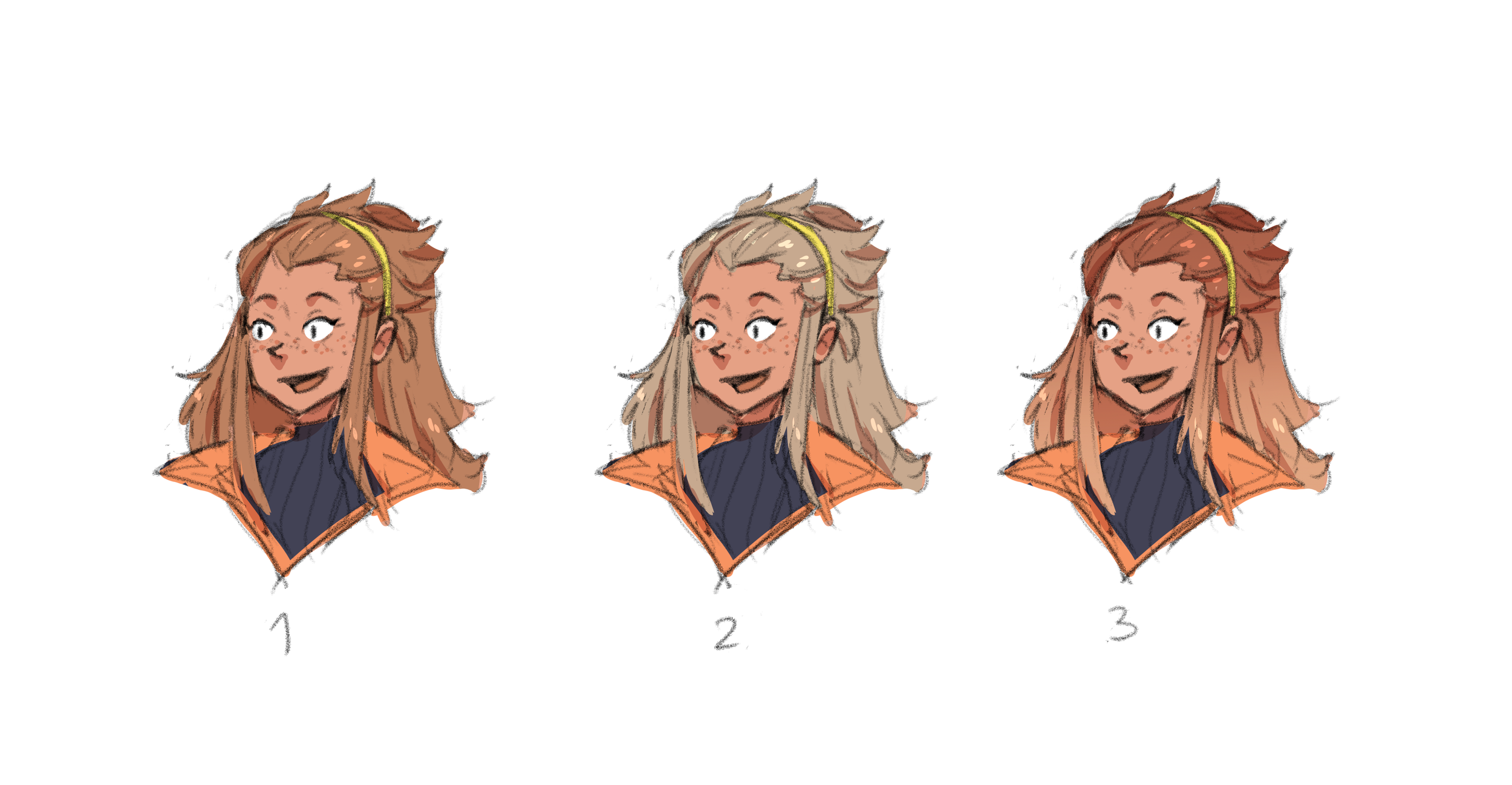
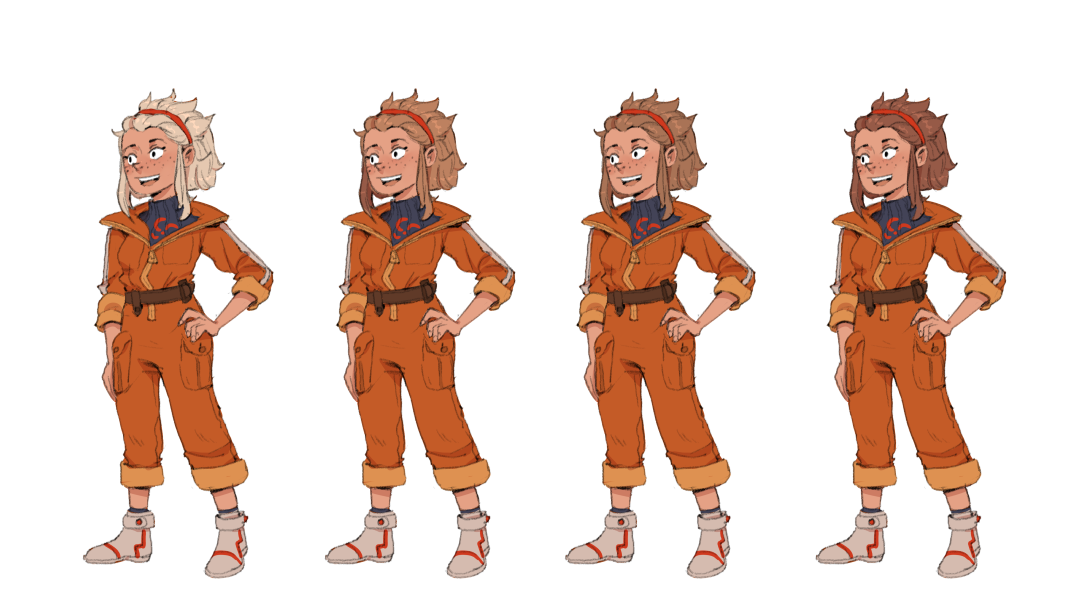
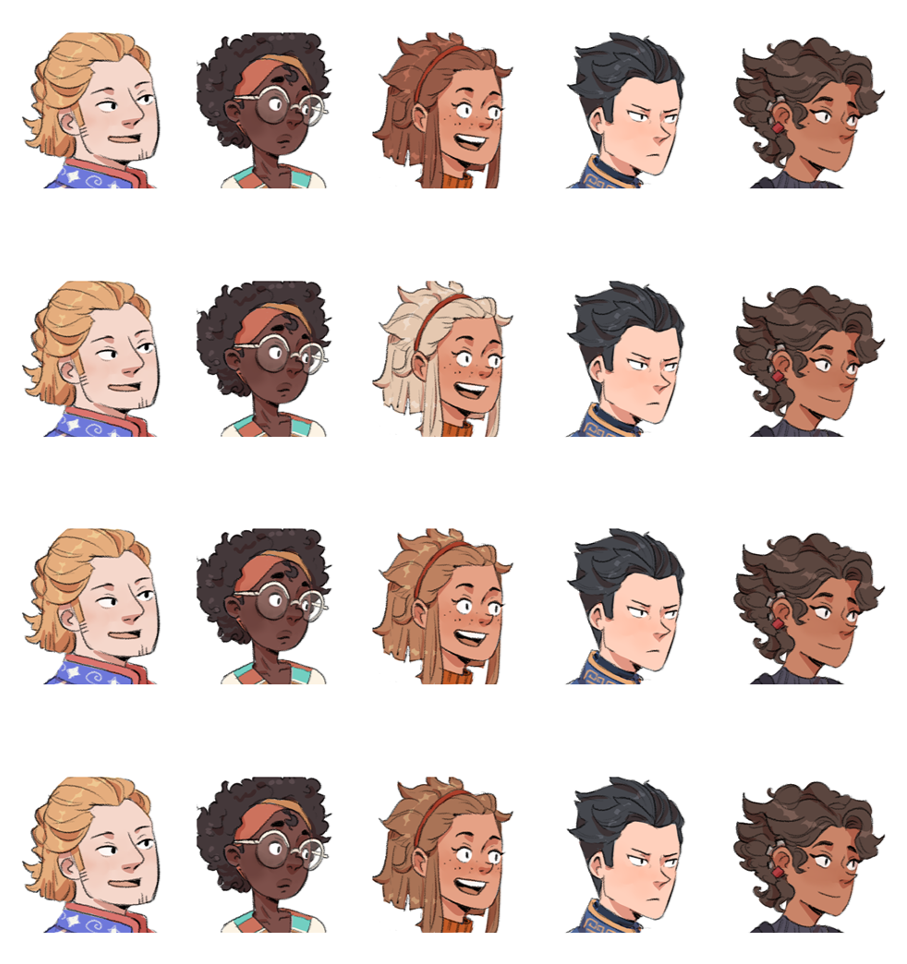
COLOR & COMPOSITION
Color was another essential element of Reva’s design.
Ultimately, we chose a hair color for Reva that we felt let her fit into the lineup without distracting from the other characters, but still made her feel visually distinct.
Flight Tech
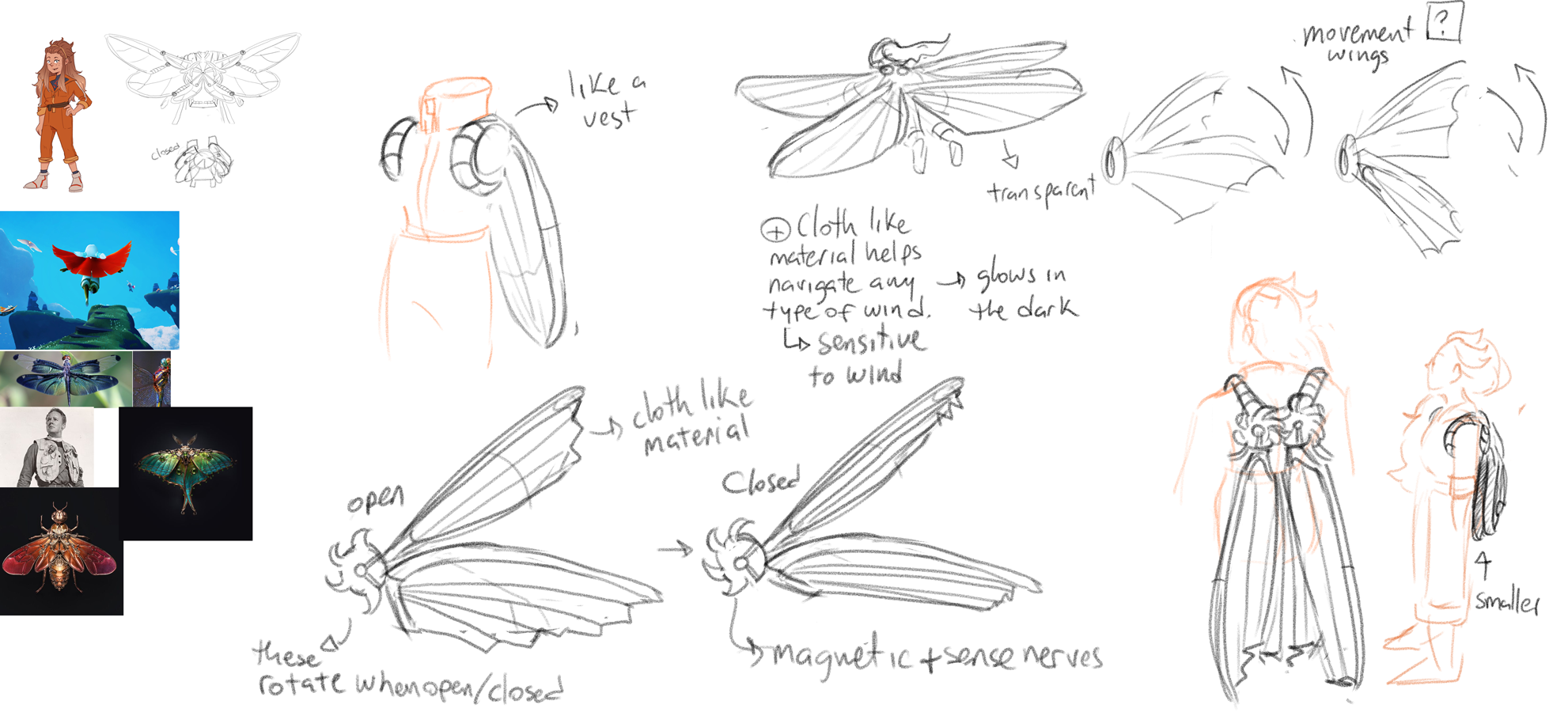
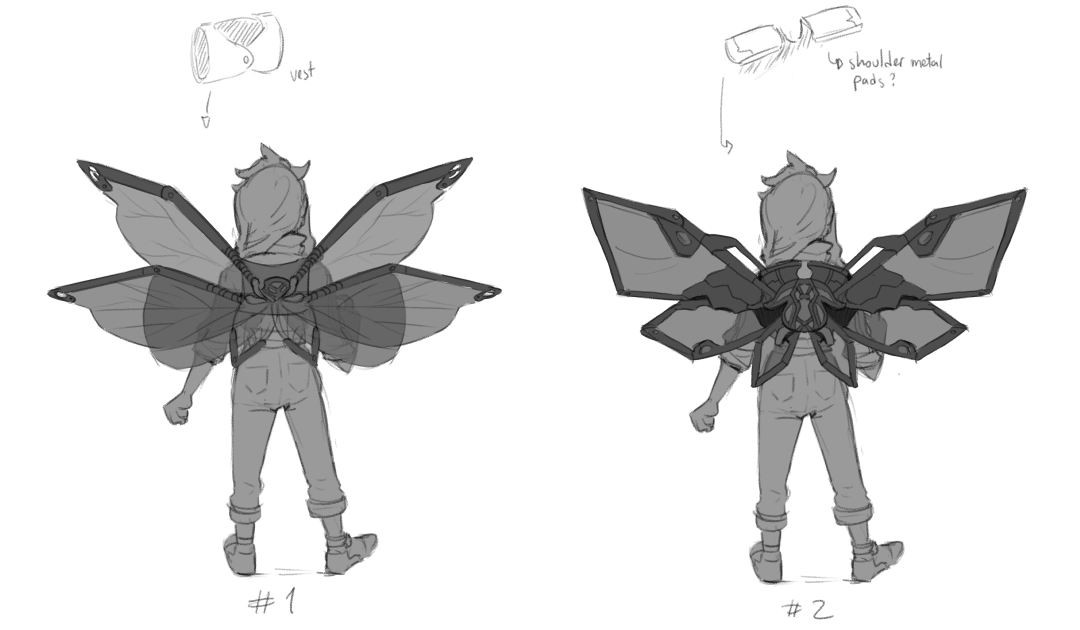
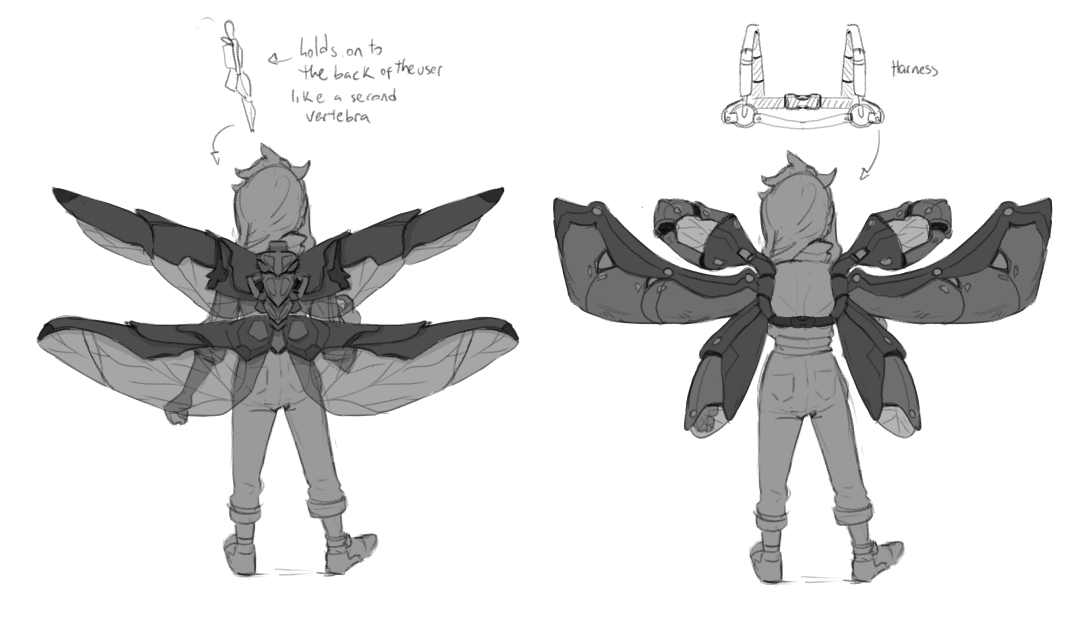
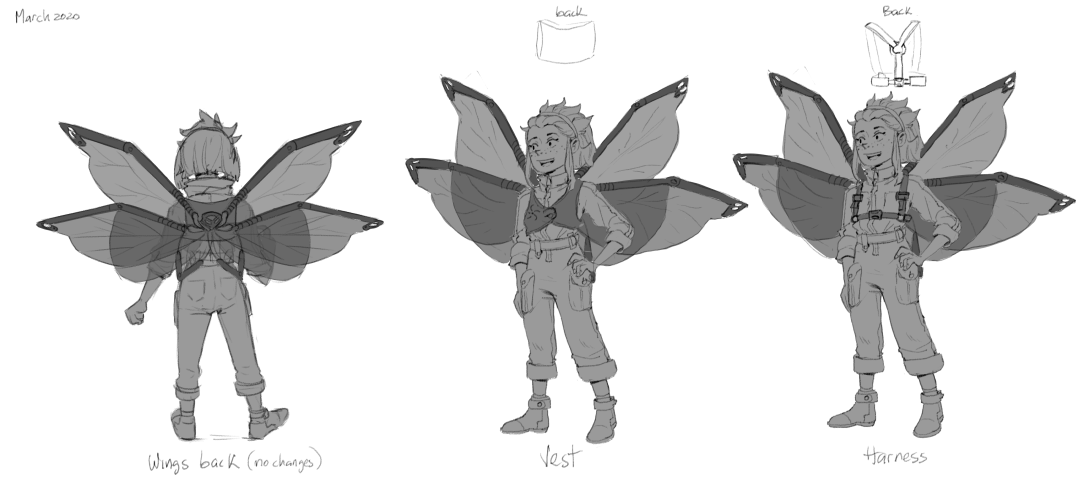
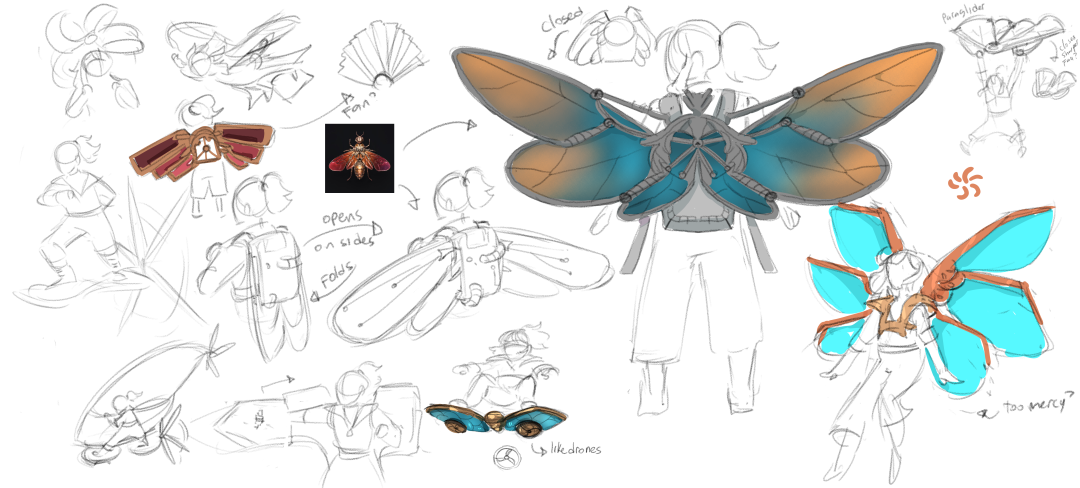
Individual flight plays a huge role in the story of Reva & The Four Skies. So, it was as important to work on the technology Reva would use to fly as it was to nail down the design of her actual character. Developing the flight tech involved a lot of worldbuilding, developing a way for the world’s magic and technology to interface. But when it came to the visuals of Reva’s glider, we had a few inspirations we were trying to balance:
Free & Flexible — The flight system needed to feel non-restrictive. After Anne’s initial design explorations we concluded that a simple harness or backpack with “back-wings” felt like the best approach to to this.
Animalistic — The dragonfly was a motif throughout the book so we thought to mimic the beautiful coloration and patterning of insect wings with Reva’s own wings.
Speculative Technology — We still wanted the flight system to look technological — even if it was a technology that interfaced with magic. Some of our designs here ended up leaning too far in a science-fiction direction.
Plausible — The science was never going to hold up, but it was important that the motion and function of the flight system still felt plausible so readers would be more able to buy into the world.
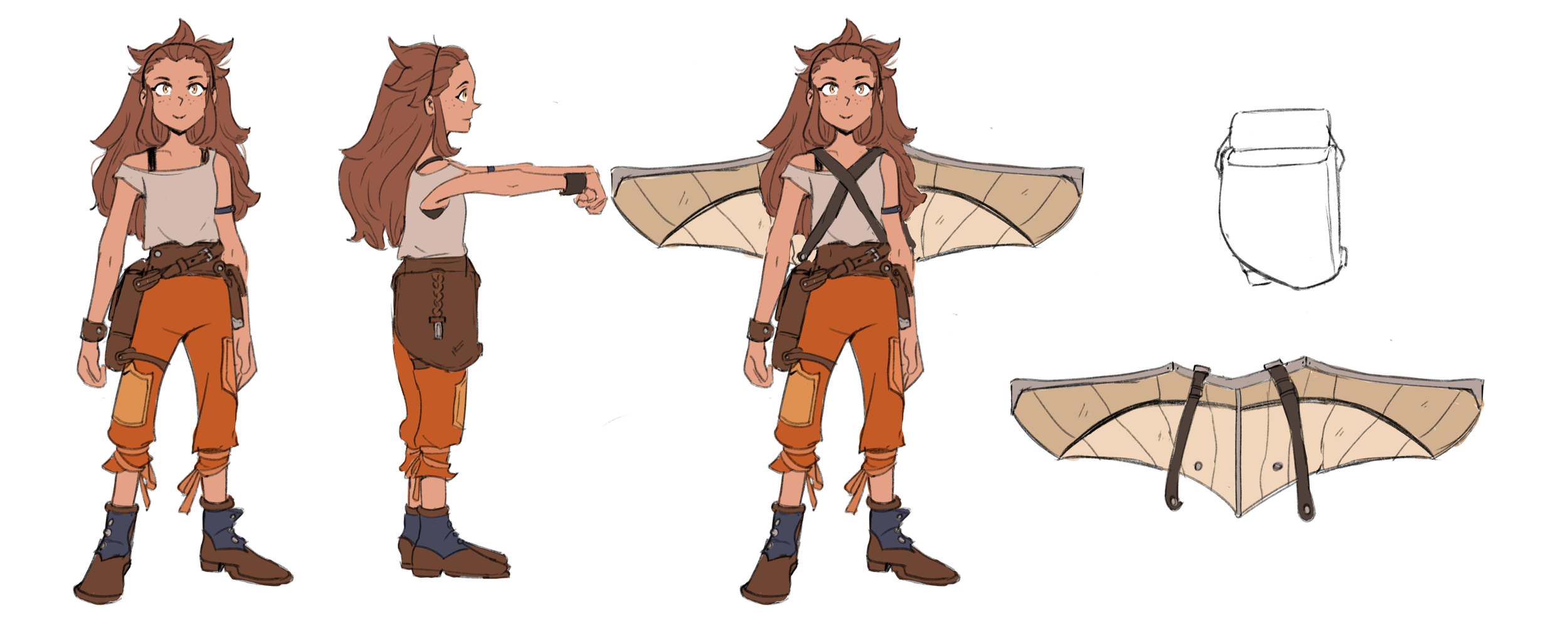
Original Glider
Later, we went back and designed one of Reva’s earliest gliders, intending for the story to show her flight system progressing right alongside her flight skills.
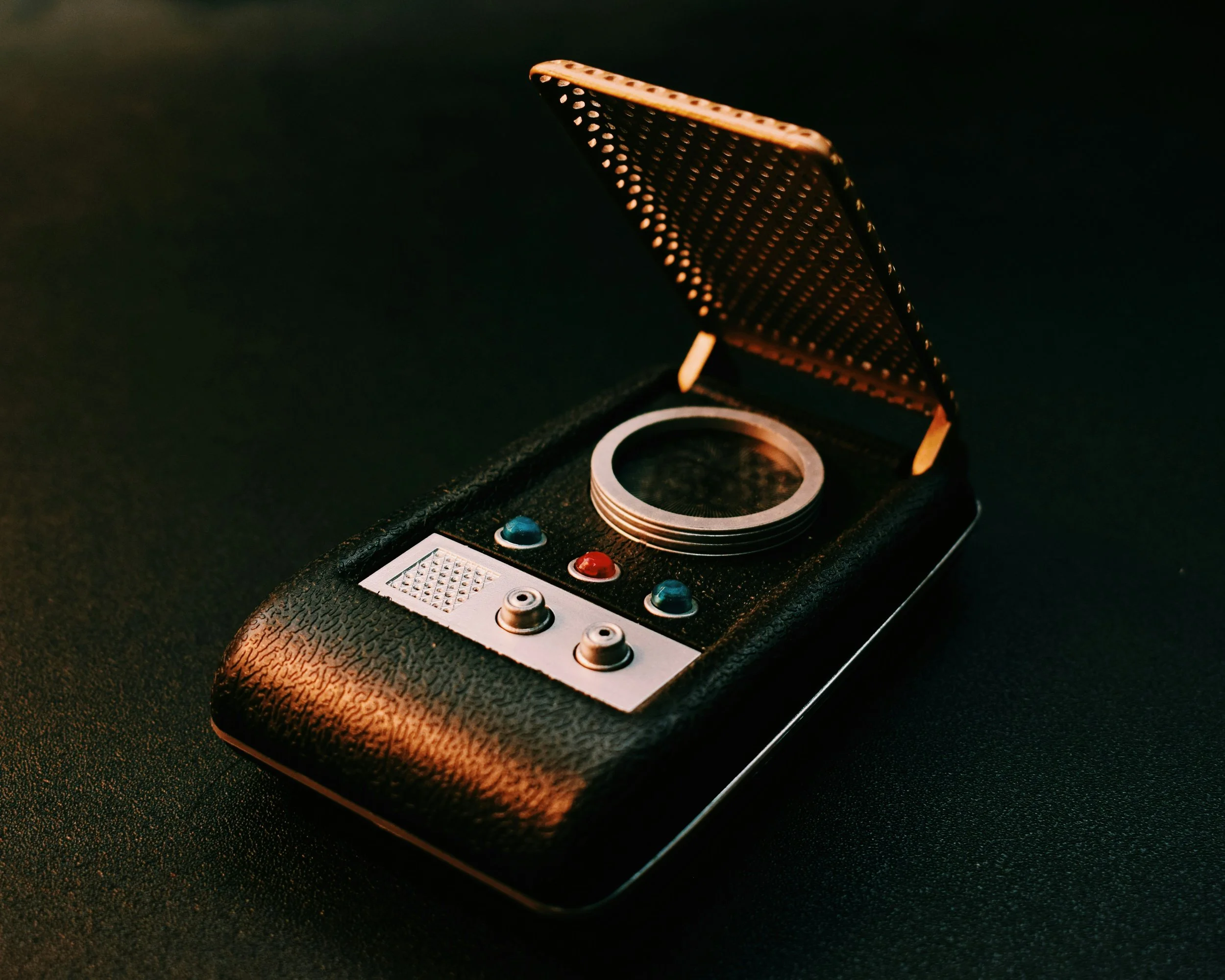
Sci-Fi Mission Giver NPC Description & Casting Call
A description and audition casting call for an important mission giver NPC for the Sci-Fighter sample game project.
For: Portfolio Sample
Type: NPC Description
Genre: Sci-Fi (Multiplayer)
Roles: Writer
Sci-Fighter is a hypothetical sci-fi game I developed for my portfolio that’s meant as a stand-in for an open-world, sci-fi multiplayer game that features both FPS combat and spaceship combat.
I have created multiple samples for Sci-Fighter, all written to work together to show how I can weave together different types of writing to created to support a single world and story. This sample, specifically, introduces an important mission giver NPC and includes a casting call in order to audition voice talent for the role.
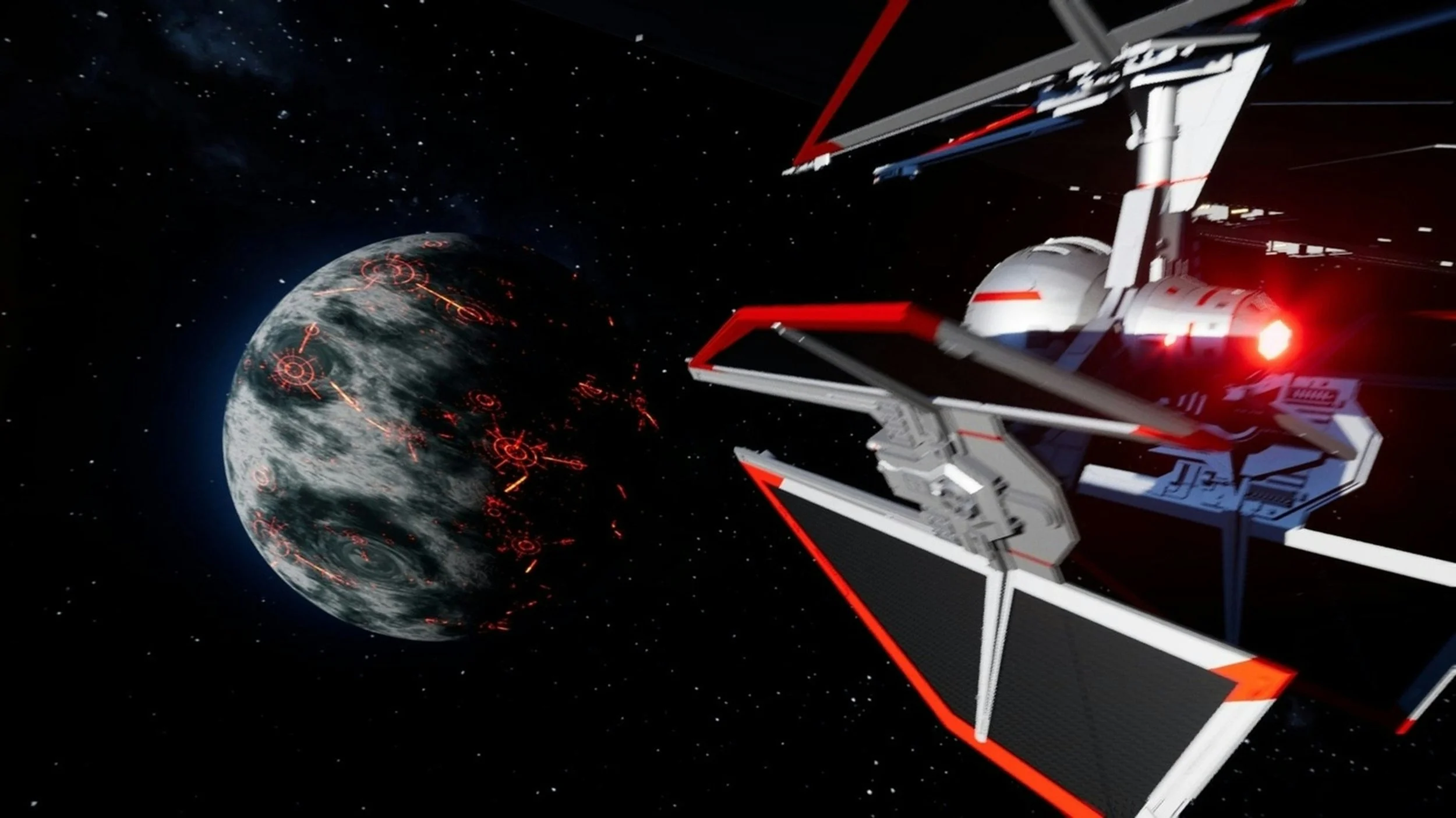
Sci-Fi Procedural Mission Objectives
This sample features the mission description and objectives for a procedurally generated fetch quest. It also includes random complications to add variety and replay value to the mission.
For: Portfolio Sample
Type: Procedural Mission Objectives
Genre: Sci-Fi (Multiplayer)
Roles: Writer
Sci-Fighter is a hypothetical sci-fi game I developed for my portfolio that’s meant as a stand-in for an open-world, sci-fi multiplayer game that features both FPS combat and spaceship combat.
I have created multiple samples for Sci-Fighter, all written to work together to show how I can weave together different types of writing to created to support a single world and story. This sample, specifically, includes the mission description and objectives for a procedurally generated fetch quest. It also includes random complications to add variety and replay value to the mission.
Sci-Fi Branching Dialogue
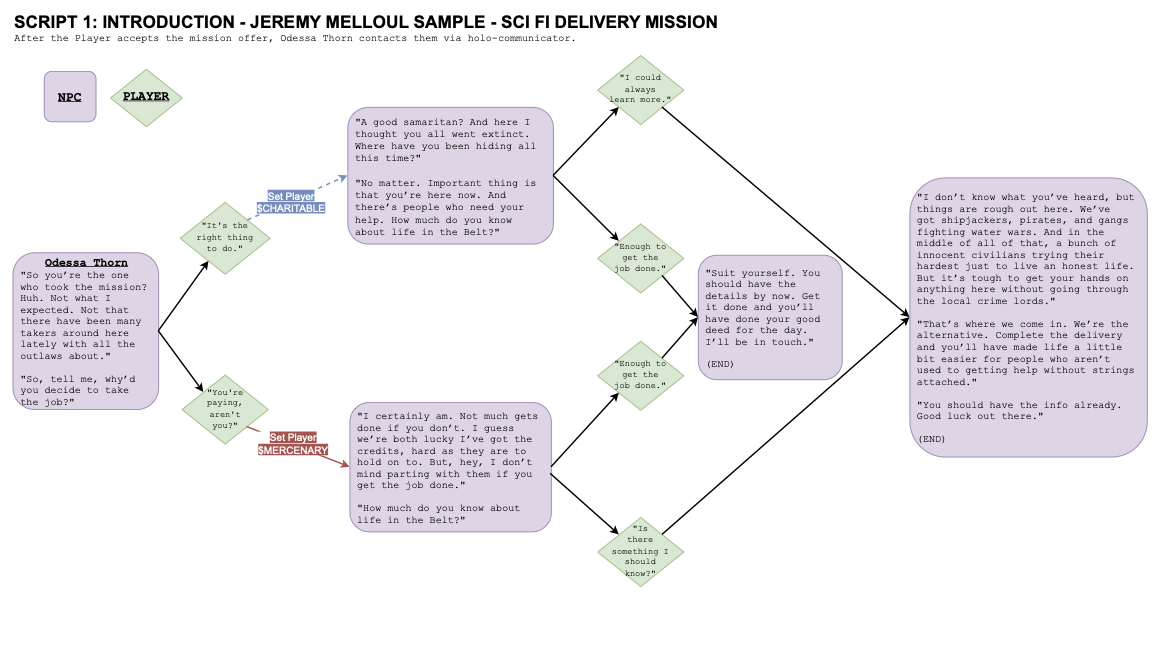
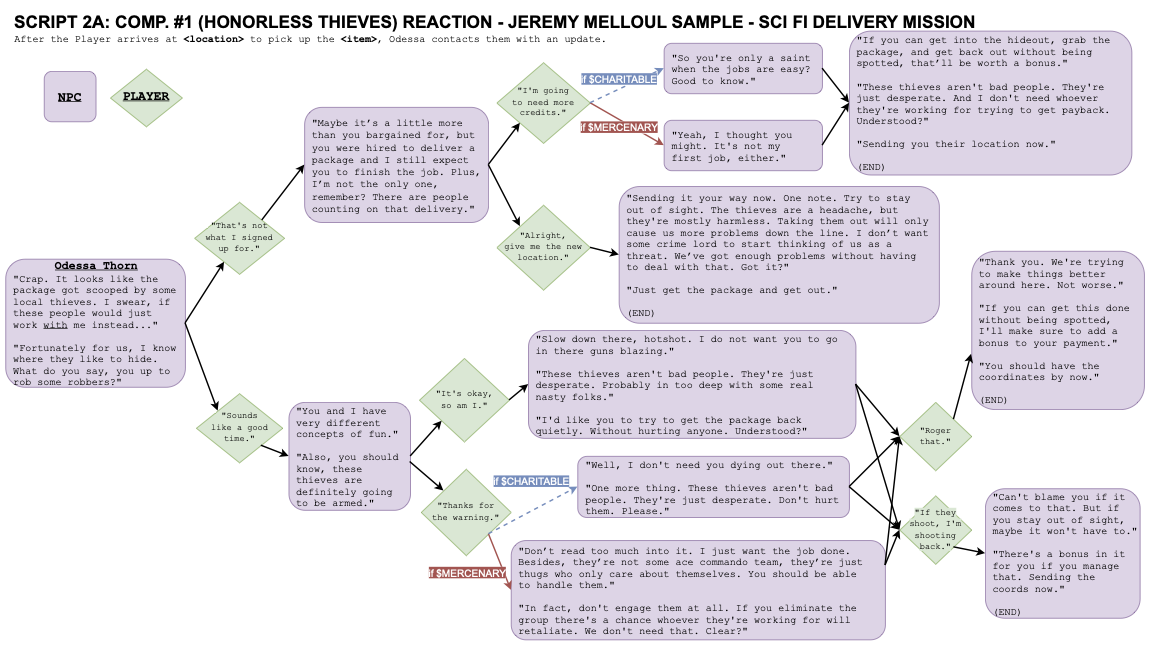
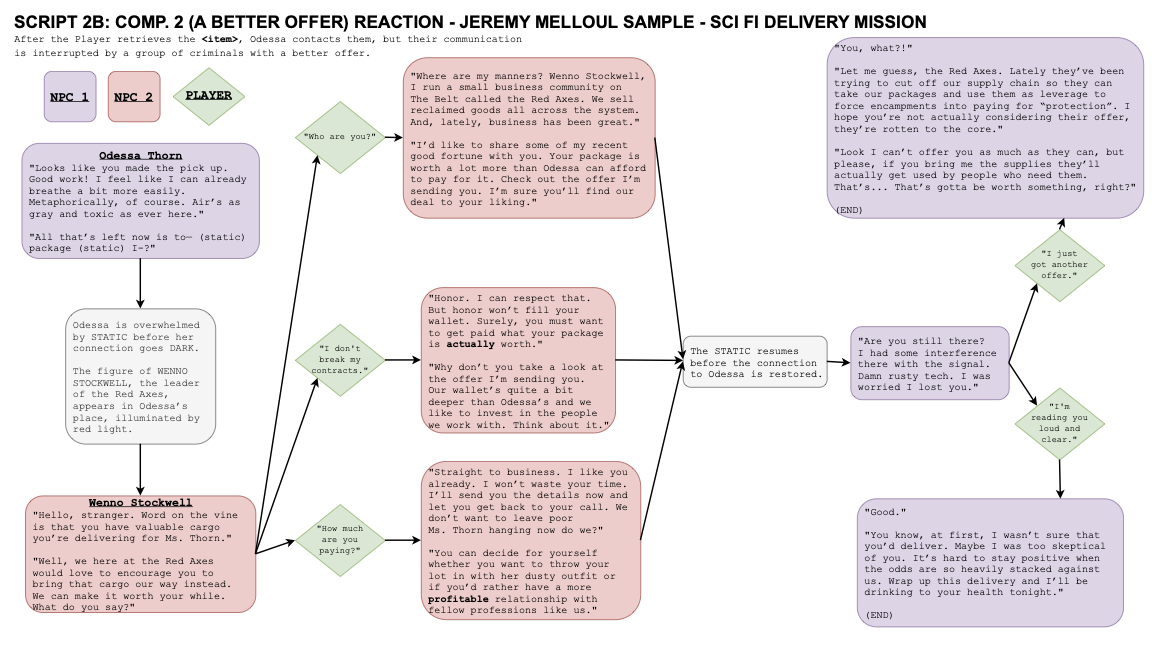
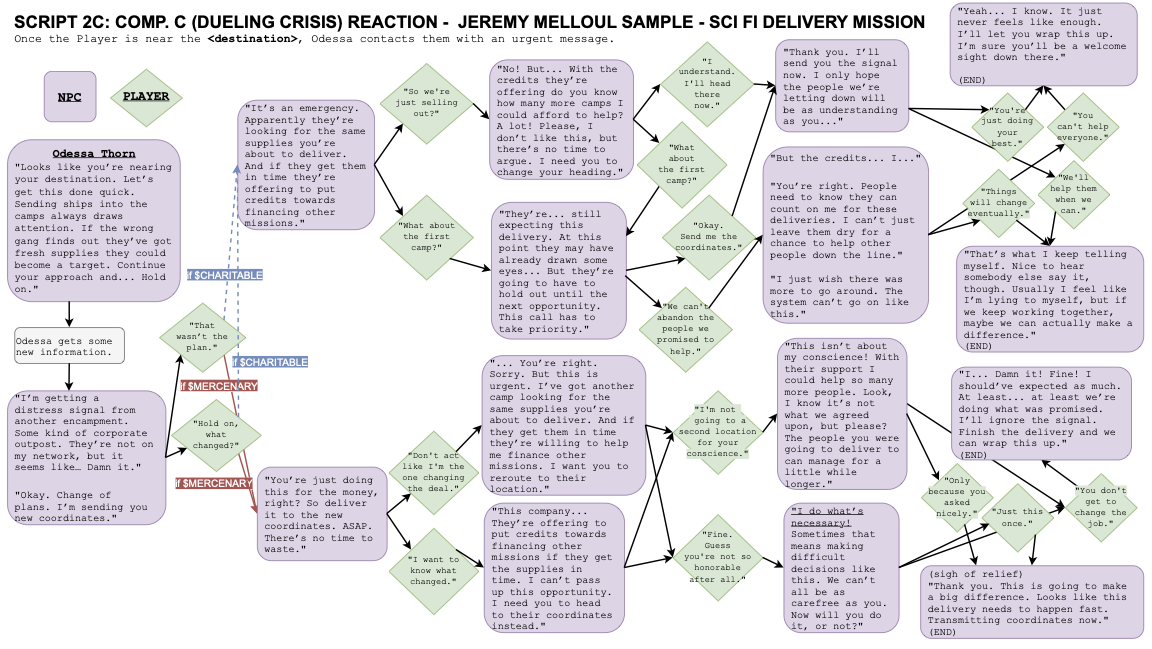
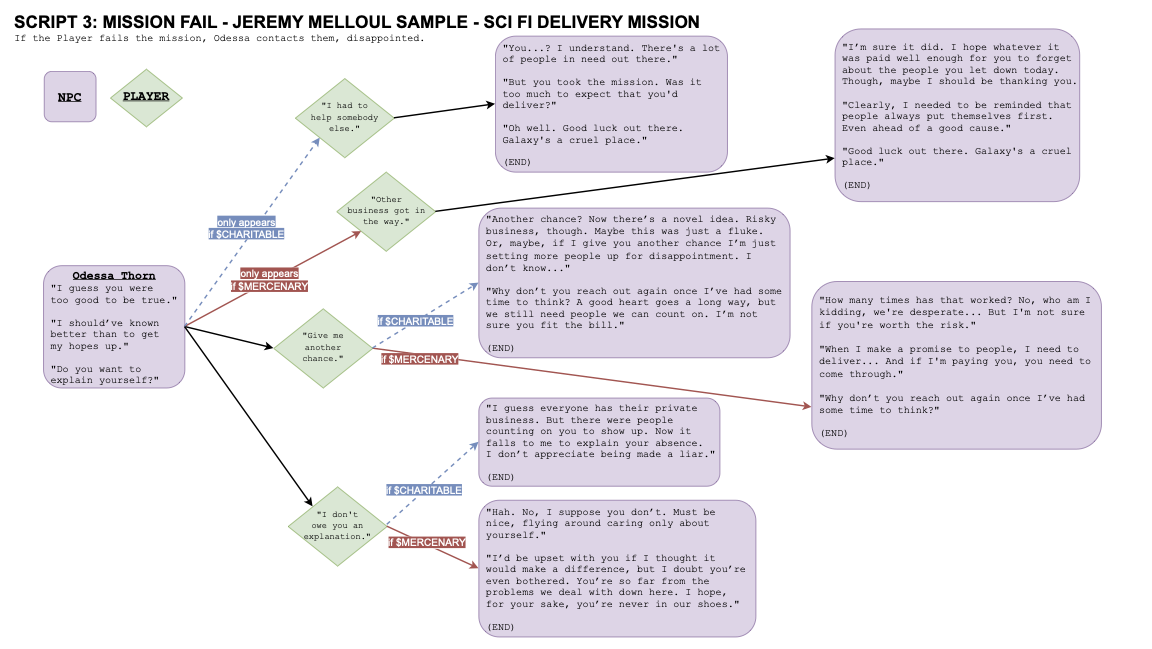
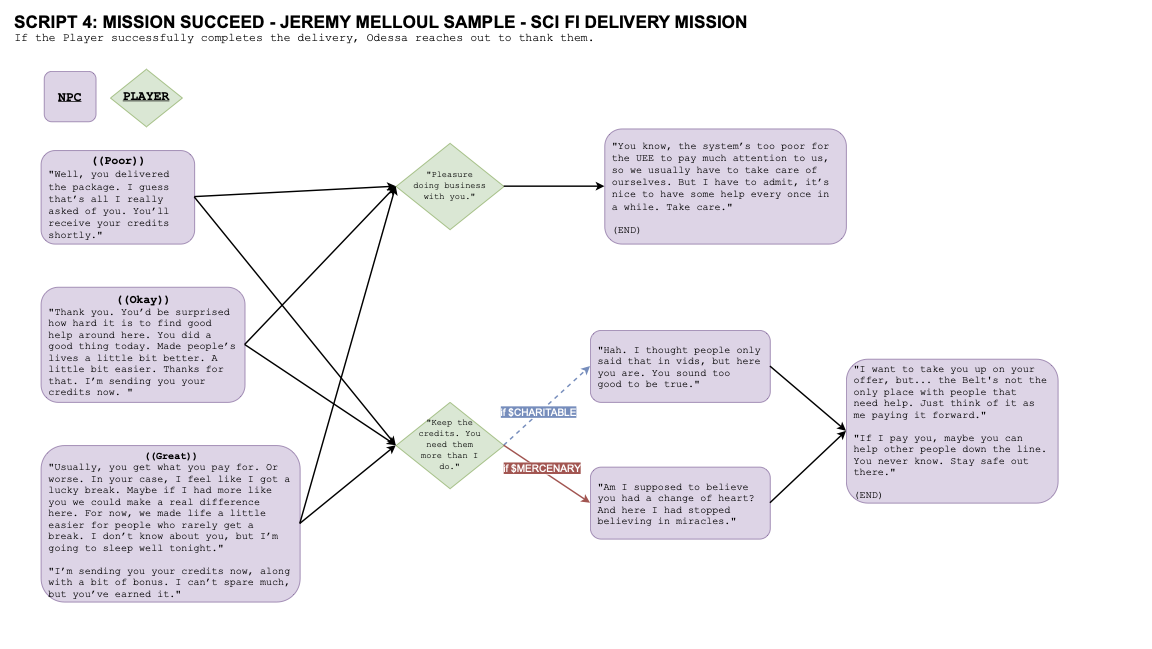
This sample features the branching dialogue for every scene/conversation players have with the mission giver throughout the quest.
For: Portfolio Sample
Type: Branching Dialogue
Genre: Sci-Fi (Multiplayer)
Roles: Writer
Sci-Fighter is a hypothetical sci-fi game I developed for my portfolio that’s meant as a stand-in for an open-world, sci-fi multiplayer game that features both FPS combat and spaceship combat.
I have created multiple samples for Sci-Fighter, all written to work together to show how I can weave together different types of writing to created to support a single world and story.
This sample, specifically, includes the branching dialogue for every scene/conversation players have with the mission giver throughout the quest.
Dialogue Flow Visualization
Sci-Fi Location Brief
This sample features the branching dialogue for every scene/conversation players have with the mission giver throughout the quest.
For: Portfolio Sample
Type: Location Brief
Genre: Sci-Fi (Multiplayer)
Roles: Writer
Sci-Fighter is a hypothetical sci-fi game I developed for my portfolio that’s meant as a stand-in for an open-world, sci-fi multiplayer game that features both FPS combat and spaceship combat.
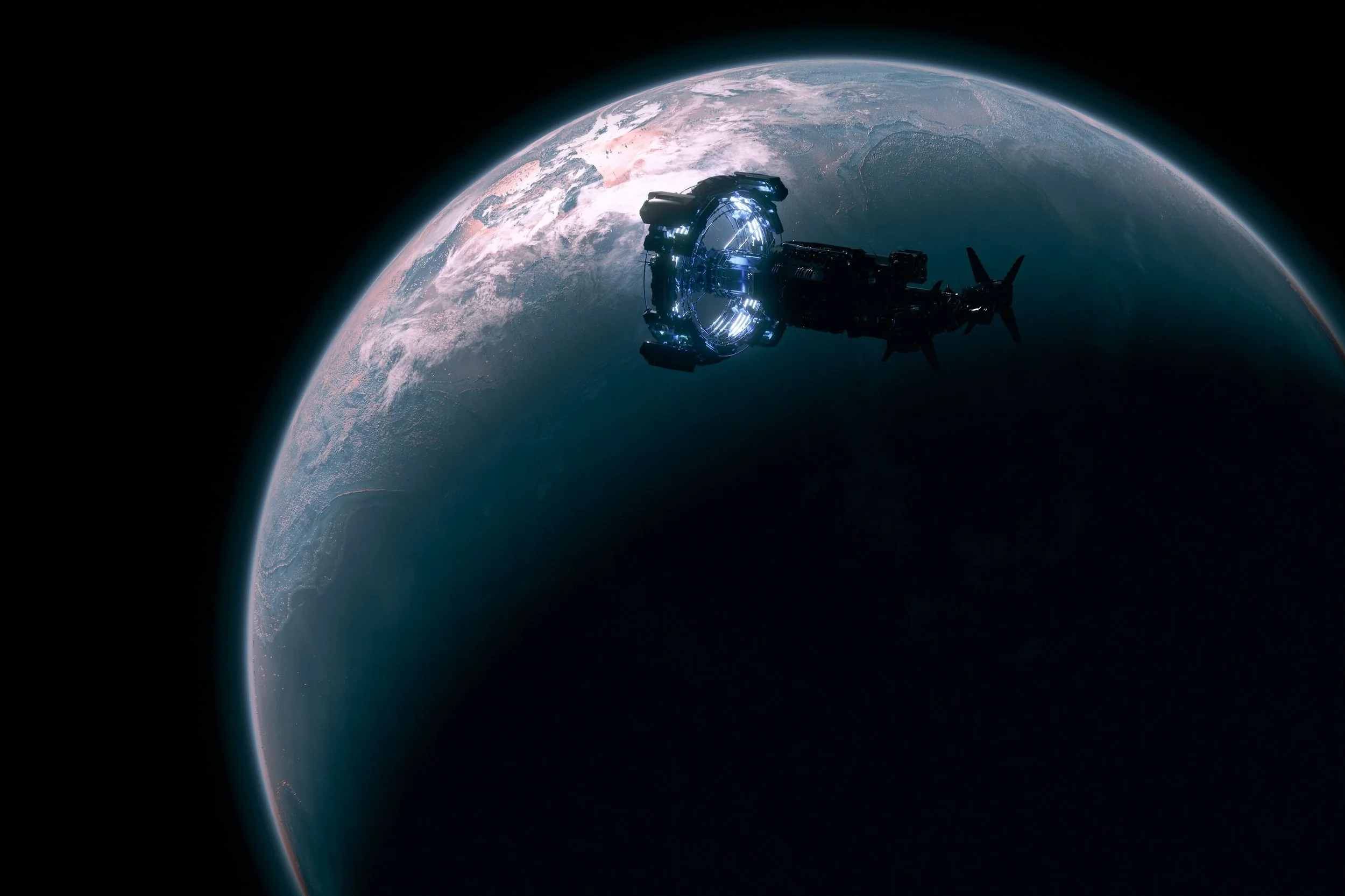
I have created multiple samples for Sci-Fighter, all written to work together to show how I can weave together different types of writing to created to support a single world and story, in this case a procedural delivery mission.
This sample, specifically, includes a location brief for one of the locations that could be included within the list of possible delivery destinations in the procedural delivery mission. It is also intended to be its own minor location that could be utilized across multiple quests.
Sci-Fi Barks
This sample features the branching dialogue for every scene/conversation players have with the mission giver throughout the quest.
For: Portfolio Sample
Type: Barks (Generic NPC)
Genre: Sci-Fi (Multiplayer)
Roles: Writer
Sci-Fighter is a hypothetical sci-fi game I developed for my portfolio that’s meant as a stand-in for an open-world, sci-fi multiplayer game that features both FPS combat and spaceship combat.
I have created multiple samples for Sci-Fighter, all written to work together to show how I can weave together different types of writing to created to support a single world and story, in this case a procedural delivery mission.
This particular sample features a set of barks for generic “Academy Cadet” NPCs designed to be found in an orbital Naval Academy (the same one described here).
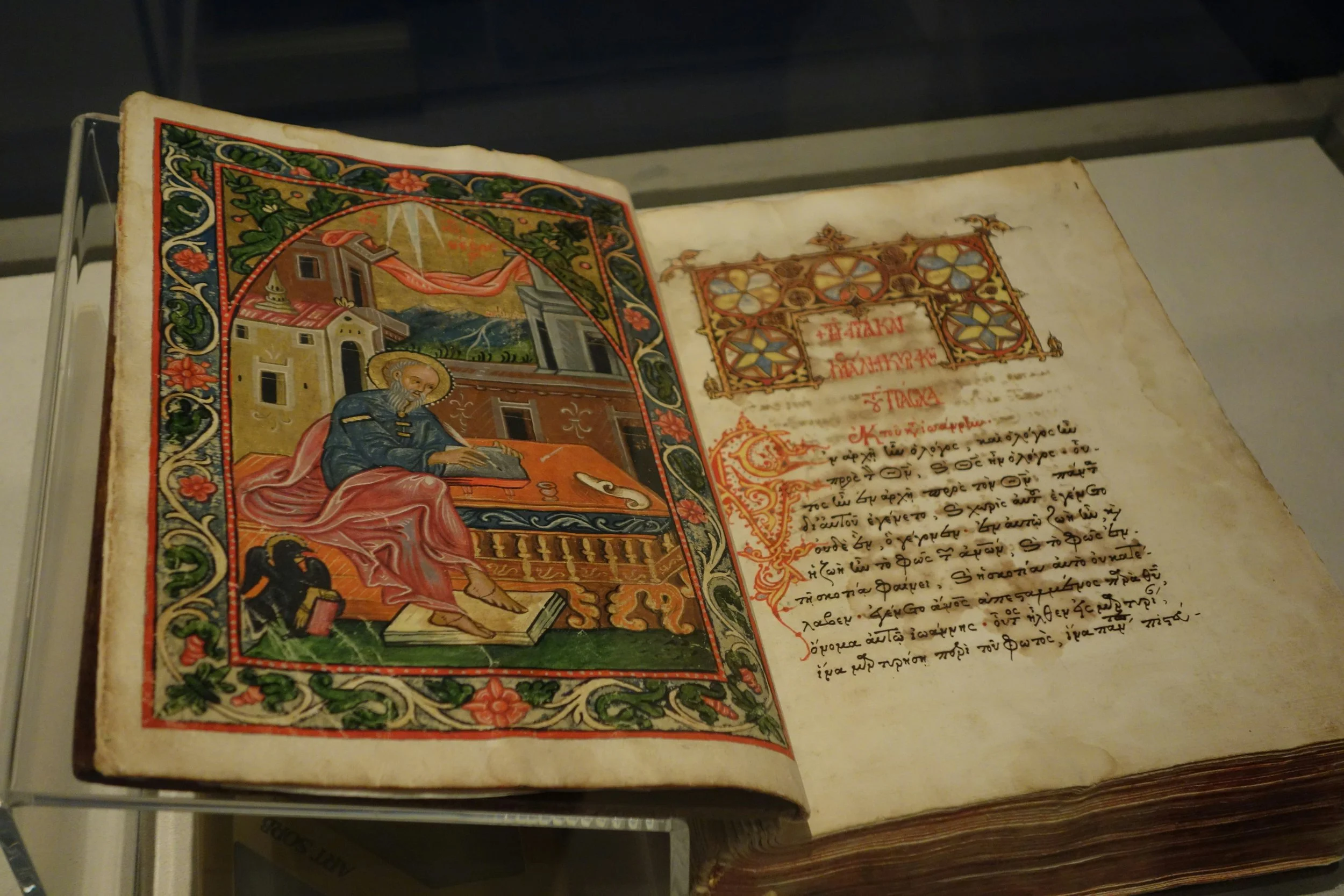
“Bardsong” Fantasy Sample Barks
Sample Barks for both a main “Bard” character and the spirits the player can summon to overcome enemies and environmental obstacles.
For: Portfolio Sample
Type: Dialogue (Barks)
Genre: Fantasy
Roles: Writer
In Bardsong you play the last of the bards, heir to a long traditional of magical storytelling. The core gameplay revolves around the player-character strumming their lute to summon legendary spirits into their own body in order to overcome enemies and environmental obstacles.
This set of sample barks features unique barks for the main player character as well as two possible spirits they can summon into their body. It also includes brief descriptions of each of the featured characters, for additional context

Carved in Stone (Short Story)
A short story set in Ancient Egypt. Inspired by what I learned about Ancient Egyptian hieroglyphs while working on a video about the subject.

Bakar and Akil’s reunion, which should have been joyous, was instead marked only by the flat, deadened clink of the chisel carving into the stone sarcophagus.
It was a familiar welcome for Bakar. This was only the latest of his many descents into the cave’s depths, and by now he no longer needed a torch to light his way. He knew the path. It never changed. And neither did what he found at the cavern’s deepest point.
It was there that Akil sat on his stool, where he always sat, and was quiet and distant, as he always was. His body was proof of the burden on his spirit. His once-tan skin was now pale in the darkness, after so long beyond the reach of the sun. His clothes, gnawed away, were now little more than rags hanging loosely over his thinning frame. And his eyes were hidden beneath a messy, unrestrained head of hair, which had grown without caution or direction, like a panic in a crowded room.
Bakar did not need to see his friend’s eyes to know the emptiness he would find there. Every time he came it only unnerved him more, the way Akil would chip away at the sarcophagus before him, playing that monotone melody of clink, clink, clink, while sitting so still he could almost have been mistaken for a carving himself.
But Bakar had not given up yet. Gathering his courage, he stepped across the threshold into the dim and lonesome cavern. Covered in dirt and sweat as a result of the journey down—which never grew easier, despite his growing familiarity with the trip—Bakar wiped his brow. The sword at his side swung in its scabbard, having kept him company in cases when he needed to protect himself… or others, if it came to that. Several pouches rested lightly along his belt. And a heavy pack sat on his back. He carried a traveler’s load. But Bakar had finally made it here once again, and so he set down the heavy pack he carried. Perhaps it was not just the journey that tired him so much.
“I’m back, Akil,” Bakar said, with a voice struggling to stay somewhere between cheerful and casual. He leaned against the heavy cloth pack.
Without moving his eyes from the intricate stonework before him, Akil paused before greeting his friend. His mouth opened slowly, like a heavy gate. His voice was raspy, worn by disuse, like a mountain of stone groaning under some great strain. “What have you brought this time?” he asked, his hands unfaltering as he continued to carve.
In the punctuated silence, Bakar pulled his waterskin up to his lips and drank deeply from it. Having quenched his thirst he stepped closer, dragging the sack along with him, until he stood right in front of the sarcophagus and across from Akil. He set the waterskin atop the stone coffin. “Some water, if you’ll drink it.” Bakar waited for an answer.
But none came. Akil remained focused on his meticulous work along the sides of the sarcophagus, the rhythmic sound of the chisel filling the silence. Bakar glanced at the dimly-lit surface. The hieroglyphs had already extended all the way around, the last time he came. Now, they had grown more intricate, like fractal patterns filling the spaces between other carvings. Once, Bakar had hoped Akil might someday simply finish the sarcophagus and be done with this madness. But now he was not so sure. And each time he left, the next trip back seemed to take even longer, as though the chasm in which Akil had secluded himself was sinking deeper into the dirt and rock. Farther from the laughter they had shared. The dreams under starlit nights. Open skies, almost unimaginable from this stone abyss.
“I’m sorry it’s taken me so long to come back,” Bakar said. “You were never an easy person to get gifts for, and now….”
Clink. Clink. Clink. The silence did not hang in the air for long; Akil’s hammer and chisel continued their eerie song.
Clearing his throat, Bakar opened the cloth sack and reached into it.
“I have more letters for you,” he said. He did not mention how few there were now. He had long ago stopped trying to convince others to make the journey down with him. But now he could not even convince them to write. Most of them. “Layla has written to you again. She misses you.” But this did not move Akil.
“Your parents, too,” Bakar continued. “Your mother and father are getting old. They still pray for you, that Isis may help you.”
Clink. Clink. Clink.
“I’ll put them with the others,” Bakar said, voice a little quieter. On the side of the room there rested a small hoard of simple treasures stained with dust. There was a pile of letters, to which Bakar added the most recent contributions. Next to the letters, there were other gifts that had piled up over the years. Bakar had carried more and more of them down here on his own, on behalf of the friends the two had once shared.
There were clothes among these gifts. Though they remained neatly folded atop a cloth, the dust had now dyed them all gray and brown, a far cry from their once-vibrant hues. Bakar drew new garments from his pack and exchanged it for the stone-colored, untouched set. As far as Bakar could tell, Akil still wore the same clothes he had worn when he first came down here. Now they were little more than rags. Bakar thought it likely that they would simply slide right off Akil’s body and turn to dust if he ever did move. He hadn’t yet, though. So that theory remained untested.
Bakar decided, next, not to reach into the large sack he had carried down; instead, he eagerly reached for a small pouch tied to his waist. As he drew open its drawstring, a beautiful and delicious smell slowly began to permeate the cavern. That delicate and mild fragrance crept along the hanging air, usurping the dry and earthen stillness of those dusty depths.
It was a loaf of bread. But not just any loaf. “I finally figured out my mother’s recipe, Akil,” Bakar said, a hint of mischief playing about his face and voice, now. He placed the uncovered loaf atop the stone coffin, leaving its aroma free to gently find its way to Akil’s nose. “You remember her date loaf, right?”
Akil did remember. Soft and moist. Mashed dates, sweetened with honey, enriched with butter. Mixed with goat’s milk and coconut. “I think I got the shape perfect, too,” Bakar said. Akil’s eyes flicked upward, even his inhuman focus momentarily helpless in the face of his curiosity. Bakar saw this and grinned. In all his time coming here, he had only rarely managed to get Akil to look away from the sarcophagus, even if only for a moment. When Bakar’s mother made date loaves she always shaped them like crocodiles. Bakar’s loaf… could have been a crocodile. If that crocodile had been trampled by a crashing boulder. “Not bad, right?” Bakar grinned at his friend.
“I’m not hungry,” Akil said, eyes already back to his work. Even in the face of this distraction, his hands had not stopped working.
Bakar’s expression fell, though hints of his grin still lingered. “No, of course not. Why would you be?” He grabbed the loaf and tore off a piece, holding it up to his nose to smell, proud. “Clearly you must be full, what with all the feasting you do down here.” His voice was a little harder now.
Bakar raised the piece of bread he had torn off to his mouth and savored it, doing his best to taunt his friend with bread that was, admittedly, nowhere near as good as what his mother used to make. But Akil did not even seem to register the taunting. Bakar had hoped that his friend’s body, at least, would respond to the smell, but it did not protest. Akil’s body was far too weak, now. The pained cries of his stomach were long dormant, as defeated as the man himself, cold ashes in an abandoned hearth. “You used to love these,” said Bakar.
Akil remembered that, too. He still recalled the memories, but when he reached for the feelings he thought should accompany them, he found they only fled further away. He recalled feeling warmth and joy, but could not conjure up the true contours of the actual emotions. And, deep down somewhere, he only felt worse, knowing that he had once felt better.
Clink. Clink. Clink.
Bakar, too, was starting to feel defeated. But he still had one last temptation to offer his friend, in the hopes of sparking the soul of this man he recognized less and less with each visit.
“I traveled to Memphis,” Bakar said, as he rifled through the sack. And indeed he had, making the long journey to the capital. “I visited the great temple of Ptah and waited there for many days to meet his artisans.” The god of craftsmen, Ptah held an esteemed place across Egypt, but in Memphis especially. There was no craftsman who did not celebrate Ptah as their patron, for he bestowed the talented with the gift of inspiration, and answered the prayers of those who called to him in advance of their work.
“I brought them the sculptures you had made before you came down here…” Bakar said, smiling at something unseen in the depths of his bag. “Do you remember the boat? You spent so long on it. Refining every detail. Every wooden board and crew member. Even the oars. You said you were trying to evoke the wear and tear in the oars. It drove me crazy how consumed you were by it all. You wouldn’t shut up about it. And even when I did manage to get you to talk about something else, every time our conversation lapsed, you’d go right back to talking about some idea you had for it.”
It was obvious, to both of them, that Akil’s work on the sarcophagus possessed the same spirit as that distant-seeming woodwork, albeit a more grim and silent one. In this cave, there was none of the enthusiasm Bakar remembered. He stood, pulling a roll of papyrus from the bag.
“I couldn’t see it at first. But when you finished it, there was no denying you had made something great.” Bakar extended the roll towards Akil. “The craftsmen in Memphis agreed. I brought it with me. To show them your skill.” Bakar continued, with greater emphasis. “This is a letter inviting you to join them. Welcoming you as an apprentice. In Memphis, Akil. In Ptah’s temple.”
Akil heard his friend. Surely such a gesture would move his heart… but there was no escaping the gray mire that drowned his spirit. He was, somehow, unmoved. His lips parted just far enough to let his raspy voice spill forth once more. “It’s too late…” he said, sorrow audible through the worn and weighty sound of his voice.
Stunned, Bakar couldn’t help but raise his voice, feelings overflowing the dam of patience he had built so high. “Too late?! Too late for what?! “ Akil did not answer. “You wanted this! I refuse to believe you don’t remember how often you used to speak of Memphis. That we would travel there together someday. We still can! The great craftsmen were impressed by your work, Akil! You have a future there!”
Bakar’s voice resounded through the cave, temporarily drowning out the clinks of the chisel. Were Akil’s muscles not so brittle that they lacked the strength for all but the slightest of moments… perhaps, in that moment, he might have flinched.
When Akil did not answer, Bakar continued. “Too late,” he scoffed. “If anything, it’s too soon. To lock yourself down here! You were—no, you are,” he corrected, “—so talented!” Bakar motioned at the sarcophagus between them. “Even now this compulsion—this curse or obsession or whatever—is unmistakably brilliant.”
Bakar was pleading now. His hand balled into a fist, creasing the papyrus. He suddenly reached within the bag and pulled out a large stone stele. Carved upon it were the naive ambitions of a young man who did not know the air he wished to soar through from the ground he walked. Akil’s ambitions. The proud, arrogant declaration of a man who had yet to forget how to dream the world.
“Do you remember this, brother?” Bakar demanded, “Because I do. I remember how much you meant every word you dreamed. How your voice was weighted with so much passion that we couldn’t help but believe it, too. Do you remember?”
Akil remembered. But all he could see when he looked upon the stele was his reflection. The portrait of a foolish soul. And an ignorant one, too. The act of someone who knew the warmth of passion but had not yet felt the chill of hopelessness that was now his home.
In the moment his concentration faltered, Akil’s next mark upon the stone cut deeper than he had intended. How fitting, he thought, to fail even in this, which he had once thought to dedicate his life to.
Still waiting for an answer from his friend, Bakar pleaded. “What are you running from, Akil? Tell me. Please. I only wish to help you.”
“I know…” Akil said.
“Then just tell me what I can do,” Bakar begged of his friend, desperate for a curse to break, a treasure to find, or something—anything—that would allow him to relieve whatever burden it was that weighed Akil down. There had to be something. If only Akil would tell him.
But again, no answer came. Bakar stood there, disappointed and stunned as his friend seemed to shrink before his very eyes, pulling further away than he had ever been. His gaze was vacant as he stared at the coffin and continued his carving. The clink, clink, clink of the stone and the chisel were monstrously callous and unfeeling.
Bakar’s eyes fell. He smoothed the papyrus out and returned it to his bag. He took a moment to pull in a breath and then release it, reaching for calm.
“I am so sorry, my friend,” he said, unable to meet Akil’s eyes. “I have brought you everything I could imagine. Seven times I have come here and each time I have left without you. Returning with new ideas, stubborn hope, and fewer friends to join me.”
Bakar took another deep breath and steadied himself, confronting his failure. “I don’t know what else to do.” Eyes now wet with the tears that had begun to form, Bakar looked back upon his long-lost friend with the mournful resolve of a man with no other choice. And from the scabbard that hung at his side, Bakar drew his sword.
The sound of the blade drew Akil’s attention, his eyes darting up once more, but this time to meet Bakar’s. Where there should have been alarm, Akil’s face was as placid as ever. But now Bakar let its stillness stoke his ire, though it made it no easier to threaten his friend. “I will not let you stay down here like this,” he said, hand clenched tight on the leather grip.
“You’d really go that far?” Akil asked.
“I would. I am,” Bakar answered, resolute.
Akil thought he should be touched by the gesture. But all he could think was that he did not deserve a friend such as this. He did not know how long he had been down here. He had forgotten. But he knew Bakar had come many times. He was sure some part of his old friend must resent him by now. Probably more with each visit, for all of his time that Akil had wasted. His hands kept working, though. “Drag me away and I will return here when you sleep,” Akil said.
“Then I will keep vigil every night.”
Eyes returning to his carving, Akil’s face remained weirdly calm. “You cannot keep your guard up forever.”
Teeth clenched and knuckles white, Bakar’s desperation urged him forward. He had never wanted to raise his hand against Akil, when they had always fought side by side. Had it really come to this? Closing his eyes to try to hold back the tears that he knew were coming, Bakar raised his sword…
…And tossed it aside. The anger that had reared its head could not match his sadness. His strength had fled along with his temper. They left behind a sort of solemn remorse, clear on Bakar’s face, his eyes almost pleading for Akil to stand and come with him.
But only Akil’s hands moved, unceasing. If anything, Bakar’s forfeiture only seemed to entrench Akil’s body more deeply. He remained on his stool, still slowly carving at the stone. Eventually, Bakar broke eye contact, and Akil returned his full attention to his carving.
Weighed down by his failure, Bakar sheathed his blade and gathered up his bag, idly shuffling around the supplies that remained within it to see him through the journey down and back. He knew that, in leaving, he would probably never see his friend again. That he would be lost forever. Could there be a more painful notion? Was that really what Akil wanted?
Hearing his friend readying to depart, Akil spoke up, eyes not leaving his work. “Goodbye, Bakar.”
No answer came from his friend. But Akil did not mind. He had never expected one. Instead his words were only met by shuffling and footsteps as Bakar lifted his pack and began to walk across the stone floor of the cavern. But Akil let the sound drift away, fading into the background as he faded into himself and continued to inscribe.
And so the cavern was quiet again.
It was only much later, in a moment of calm between carvings, that a noise caught Akil’s attention, coming from the side. Akil’s head swiveled, gentle with weakness, to look. It was Bakar, his eyes closed, sitting on his pack. What was he doing here? Hadn’t he left? Seeing Bakar resting there, Akil felt a surprise and confusion that he hadn’t thought were possible anymore. And, for the first time since he had first sat down here, his hands stuttered. The rhythm of his carving halted. “Weren’t you leaving?” Akil asked.
Bakar opened one eye and stifled a yawn, which slowly turned into a smile as he saw Akil’s stunned expression. His expression soft, he gazed back at his friend. Bakar spoke. “I’ve tried that before.” And indeed he had. Bakar had traveled far, seeking any treasure or reminder that might prove a balm to his friend’s spirit. But even after many years, Bakar still did not know the nature of his friend’s affliction. And now, he realized, he might never know.
Neck protesting from the strain of turning after so long spent facing forward and down at the early grave before him, Akil could barely find the words. “I did not ask you to stay.”
Bakar shifted on his pack, trying to flatten out his makeshift seat’s uneven surface. “No, I suppose not,” he said, as he found a position he didn’t mind. It wouldn’t be comfortable, it never was down here. But if he couldn’t scatter the shadows that had taken root in his friend’s heart, then Bakar could at least stay here a while. Cold as the darkness was, it always felt a little warmer when they sat together.
A long moment of silence stretched out. Akil slowly turned back to face the sarcophagus. A few moments later he spoke up again. “You should have brought a stool,” he said.
Bakar blinked, surprised by his friends’ response. And in the long tunnels that stretched from the bright desert above to the frigid stone caves deep below the ground, where two friends sat, the low rumble of laughter echoed softly.
Written by Jeremy Melloul // Edited by Chris Montgomery

Thunder From a Clear Sky (Short Story)
A fantasy short story produced for Gateways, a science-fiction & fantasy reading series at the Otherworld Theatre in Chicago, in which writers compose a short story in response to a prompt in a limited time period and actors read the stories to a live audience. The prompt for this story: “These human children are adorable. Let’s keep them!”
Earlier this year I received a prompt by email and, within 5 days, had to write and deliver a three-page short story in response. The prompt was: “These human children are adorable… Let’s keep ‘em!” and the occasion was the Otherworld Theatre’s Gateways reading series, which takes sci-fi and fantasy short stories and has actors read them aloud on stage at the amazing Otherworld Theatre in Chicago.
Below you can listen to the reading of the short story I wrote, “Thunder From a Clear Sky”!
I hope you enjoy (or enjoyed) the reading and the story! If you did, please share it and check out more of the Gateways shorts for awesome sci-fi and fantasy storytelling!
Transcript
TRANSCRIPT: This story is written by Jeremy Melloul. He’s written for as long as he can remember. Since deciding to pursue writing professionally, he has been focusing on writing fantasy and science fiction across media, mainly comics for the last few years. Jeremy tells us that growing up, stories were his escape from a difficult childhood. Today he works to create stories of his own that not only allow people that same sort of escape into imaginary worlds, but also allows them to return to their lives better off for the time they spent away. This is “Thunder from a Clear Sky”.
The sudden explosion takes me by surprise. A trap? They’ll have to do better than that. I already have what I came here for. The treasured scroll is mine, the dry parchment held securely in my clawed grip.
After the blast, the scroll chamber is in worse condition than I am. Part of the wall is now rubble and the ancient carvings upon it have been shattered, profaned in a desperate defense.
From somewhere behind me a loud yell reverberates through the room. I turn around, but can’t make out anything through the dust. The explosion was just a set-up for this! Through the cloud a heavy spear thrusts forward, aimed low, towards my stomach – the only part of my body bereft of scales.
My hand lunges for the spear. It pierces my armor, but I stop it before it reaches flesh. The cold metal struggles to inch forward, but despite the attacker’s effort, I keep it bay,
As the dust settles, the spear begins to shake. The human must be realizing who I am. A shame. My years of conquests were supposed to give rise to greater resistance, but instead only broke the will of those who might fight me. Now cities surrender at the sight of my army’s banners. And even the most valiant warriors fear dying upon my horns, or seeing their blades break upon my scales. An unfortunate consequence of my victories.
The dust clears, revealing the figure still desperately pushing the spear forward. It’s a child. A boy, by the look of him. Small with short blonde hair and dressed in a temple attendant’s robes, which is now covered in dust. Though I stand more than twice his size he still attacked. He even went as far as to plan a trap to increase his chances… which means he thought he stood a chance to begin with. Foolish.
Though he shakes, he does not shake with fear. Well, not just fear. There is also rage there. And I can’t help but smile. A hatchling attempting what its parents will not…
But he is still human, unfortunately. And these soft-skinned beings are easily broken.
“Now!” the child screams, his eyes darting up. I follow his gaze up to the rafters, where two slightly younger children, also dressed in dirty attendant’s clothes, step out of the darkness and empty a large sack of rocks over my head. My arms instinctively rise to protect myself, and the rocks crash harmlessly against my scales. There’s more to his plan? Surprising, I-
A sharp pain in my gut shatters my line of thought. I look down and see the spear I had been holding has pierced my skin. Slowly, blood seeps from the wound, green and blue, running along the weapon’s edge.
A shallow injury, but how long has it been since I last bled…
With a roar I slam my scaled arm down against the wood of the spear, snapping it in half. The child’s hold on the weapon broken, he steps back, frightened. Years of conquest and a hatchling is the first to make me bleed. I should be offended, but instead, my interest is piqued. Why does this one still struggle when the warriors of his kind surrender?
I pull out the broken spear from my body, throw it aside, and turn my attention overhead, to the other children hiding in the rafters. Are they the same?
Still holding the scroll in one claw, I call on my Way of Fire and will a flame into existence in my other palm. Its glow covers the room in an unnatural green light and fills me with warmth – a reflection of my power, which turns all obstacles before me into fuel for my growth, like wildfire in a verdant forest.
Without a worthy foe, my fire is not what it once was, but it is more than enough to deal with a few whelps. With a thought, the flame stretches from my hand in an instant – a ray of flames surging overhead, consuming the wooden rafters the children above are hiding in.
Disappointing. The fear is obvious on their faces as they scramble away from the flames.
“Leave them alone! Screams the other child, running straight for me, undeterred. Perhaps it’s just him, then. The other two are just like their craven progenitors.
He throws himself at me, grabbing onto my arm and trying to pull away the fire from his kin. But his weight is negligible. Despite his weakness he pulls harder and harder, desperate to save them. Good. Anger can motivate.
Having seen enough, I withdraw the ray, but keep the flame circling in my hand and grab the little hellion by the shoulder, his clothing catching fire as my grip tightens around him. I wrench him off of me and lift him up to eye level.
“You are a credit to your kind, hatchling. What is your name?”
The boy just glares me, silent, his blue eyes tinted green by my flame. I tighten my grip as the fire twists the skin beneath his clothes, and his face contorts in pain. “Speak. Or your kin will burn.”
Despite the pain he must feel his glare does not falter. I can see it in his eyes… A desire to fight. How long has it been since anyone’s looked at my like that?
Then he opens his mouth and answers. Not with words, but with a wet glob of spit that splatters on my face…
Insolent! Using my full strength I throw him aside, sending him careening towards the wall. He slams against it hard, and falls to the ground, crumpled.
Another blast of fire to the rafters overhead and the wood rips loudly as the structure falls apart, crashing to the ground, the terrified whelps falling along with it. Step by step I approach, my flame continually spinning around my hand. The other child has merit, but they are useless. So I will give them purpose as fuel for my flames.
“Wait…” the other child croaks.
I stop, mostly out of curiosity, and look back over my shoulder as he pushes himself up, blood staining the corners of his mouth, his scorched clothes now in tatters. He holds a piece of burning wood fallen from the rafters in one hand, and a scroll in the other. My scroll!
I was just holding it. How did he-
He lets it unroll, the fire almost licking the edge of the aged parchment. “Let them go or it burns…”
“Watch. Your. Tone.” I say through gritted fangs.
“Let them go!” he demands.
The other two children cower in fear, holding each other tight. Am I really going to allow myself to be humiliated by a human hatchling? Ridiculous… But I want that scroll.
I clench my fist and smother the fire in my grip.
The unruly child calls to the other whelps. “Teo. Sora. Go! Run! Get out of here!”
“But, brother…” answers one.
“Just go! I’ll catch up!”
Quickly, the two small children run out of the chamber. Their footfalls grow distant. When all is silent again I extend out my hand, expectantly.
“The scroll,” I say, a growl underscoring my words.
And then, the child just smirks.
“Watch your tone,” he mocks as he touches the burning wood to the scroll. And in a single moment the dry old parchment catches, consumed all at once.
“NO!” I charge forward, knocking the little demon aside. He slams into a pillar and falls to the ground, limp. But the scroll is already gone.
My rage surges and the fire comes, unbridled, billowing out from me, scorching the remains of the chamber walls.
How dare he! The little bastard!
I turn my attention to his unconscious body. It would feel so good to turn him to ash…
But as he lies there, already defeated, a question takes hold of my mind. Why? He fought in spite of his fear. Made me bleed. Robbed me of what I wanted. Why was he able when no adult of his kind was? The answer comes, a whisper at the edge of my consciousness. Limits. The child has yet to learn his. To him, anything remains possible. And perhaps, he’s not wrong. Though he is weak right now, all the right pieces are there. What could he become with the proper training? The proper resources…
My temper subsides and the fire dies down. On the Way of Fire, I can only grow with an obstacle in my path… And I have long lacked a proper foe. Perhaps it is time I raise one of my own.
I grab the boy by the neck, careful not to squeeze too tight. He smells like burnt meat. His skin scorched to the bone from where I gripped him. But he still breaths.
Outside the temple, the Jade City has been broken. Fires consume the ships that hoped to escape and the waterways run thick with the blood and bodies of the fallen. Near the docks I catch sight of a trio of my ravagers, looking hungrily at their next meal… the two young ones from earlier.
“Stop,” I order.
“I want them alive.” The burned one went to great lengths to save them. They must be important to him. Weak though they might be, they will make excellent motivation for my new protégé…
Thank you, Kim. Kim Fukawa has been seen all around Chicago. Most recently she has worked with The House Theatre, Lifeline Theatre, and Babes With Blades Theatre Company. She is an artistic affiliate and occasional fight choreographer with Babes With Blades.
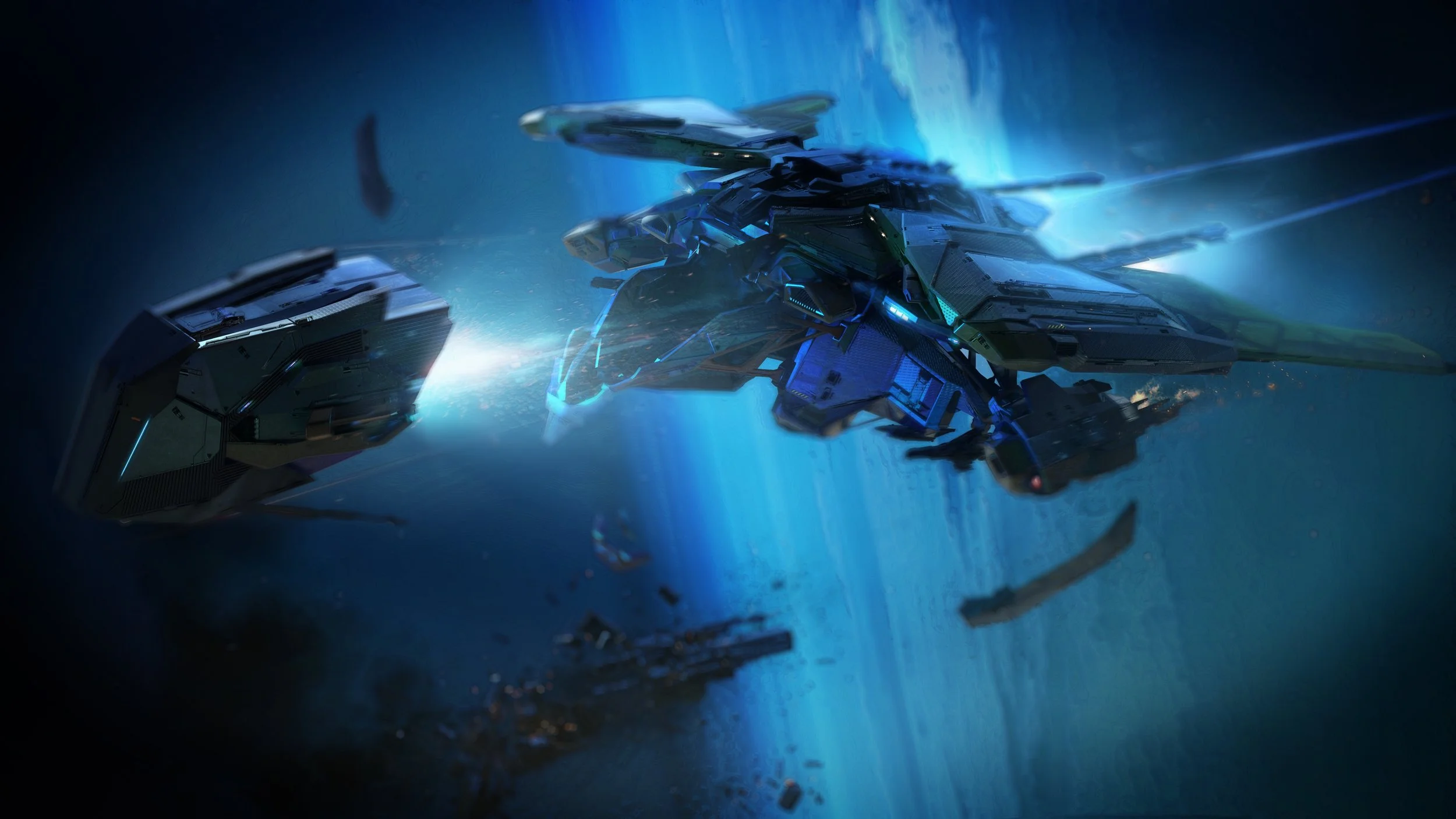
Crossroads (Short Story)
Crossroads is a short story about a pirate who’s forced to crash land in an old scrapyard to try and escape a relentless bounty hunter. The story was meant to explore the complex political perspectives of an alien species through the lens of a character-driven action story.
For: Cloud Imperium Games, Star Citizen
Type: Short Story
Genre: Sci-Fi
Roles: Writer
While working as a writer at Cloud Imperium Games one of my responsibilities was to contribute original lore and worldbuilding through articles and short stories published on the game website.
Crossroads was one such story about a cornered pirate attempting to escape a relentless bounty hunter, and their climactic showdown in an old scrapyard. The story was meant to explore the complex political perspectives of an alien species through the lens of a character-driven action story.
It happened to be very well received by the fanbase.








It was a fast descent to an early grave. In what seemed to be an appropriate location, too: a large scrapyard full of derelict ships and industrial equipment that had likely been picked clean long ago. What was left was too unstable to be safely, or profitably, salvaged.
Now there would be one more ship in this graveyard.
Krenn’s Talon smoldered and sparked as clouds raced by his field of view. All sorts of alarms were yelling at him as if he wasn’t already aware of the danger he was in. The Tevarin pirate tried to wrestle his ship into control but could do nothing to slow his fall.
With no better solution available to him, and as much as he didn’t want to abandon his cargo, he decided to abandon ship. As he ejected the pod, his console lit up with warnings. The cockpit of the Talon was supposed to separate from the rest of the vessel, but the damage to his ship had impacted the latches. They didn’t detach properly, but the cockpit tried to fire anyway. The force of the ejection ripped the latches out of place and sent his cockpit spinning wildly.
Krenn only caught glimpses of the rest of his ship hurtling deeper into the field of scrap as his cockpit crashed through piles of loose metal. Hitting the ground, he tumbled end over end before finally coming to a stop seated upside down.
The pirate caught his breath and ripped his helmet off, letting it fall to the ground. His skull stung as air touched the freshly bleeding wound upon his head.
His cockpit was in tatters, the canopy shattered, and the walls pierced in multiple places by loose scrap. Worst of all, a large piece of shrapnel was embedded in his left thigh, pinning him to his seat.
Krenn slowly gripped the shard of metal and wrenched it free. Immediately, blood began flowing from the wound, spilling down into his cockpit. He tossed the shard of metal aside and tried to detach his seat straps, but they refused to disengage. Frustrated, he reached behind his seat and pulled the bakor from its lodging.
The bakor was about the size of a hatchet, but instead of a single axe head the weapon had three edges: the standard axe head and then a small fluke jutting out opposite the main blade, as well as a short, sharpened spike extending from the top of the weapon between the two blades. It was uncommon, but the traditional Tevarin weapon was the pirate’s favorite tool.
Krenn cut the seat straps away and fell to the ceiling of his cockpit, wincing as his wounded leg screamed at him. He looked at the injury, still pulsing blood, and then cut his seat straps again, using the material to fashion a makeshift tourniquet which he tied around his leg to staunch the bleeding. Immediate death now held temporarily at bay, he pulled himself out of the shattered remains of his cockpit and into the dumping ground around him. For as many fights as he’d been in before, the pirate was sure he had never looked this bad. He sheathed his bakor in the holster at his waist.
The sound of a ship’s engines, distant but growing closer, sent Krenn’s adrenaline spiking. He ducked out of sight.
The bounty hunter was coming.
The hunter’s approach stirred a strong wind that carried through the junkyard, eliciting a chorus of groaning metal in response as the unstable ships throughout teetered, threatening to topple over. Krenn watched the Avenger pass over him and head towards a plume of smoke that was slowly rising into the sky.
His crashed ship.
Where, hopefully, his cargo remained. That cargo was the whole reason he had gotten into this mess. Infiltrating the security post hadn’t been any more difficult than usual, but after that everything had gone to hell. Not only had his exit been even bloodier than planned, but then Jorg Tala, that damn bounty hunter, had come out of nowhere, isolated Krenn from his crew, and sent him crashing down here.
Jorg had been systematically hunting down members of the Ashen Haunt for the last few months, but Krenn hadn’t thought he’d become this much of a problem. Based on the fanatical way Jorg was targeting his gang, he had no doubt the hunter was another xenophobe trying to relive Humanity’s glory days triumphing over an alien species.
The pirate watched as the bounty hunter’s ship descended out of view, landing near the smoke. The hunter would undoubtedly investigate his Talon’s crash site and Krenn was determined to not let that bastard get his hands on what he had worked so hard to steal.
In a way, Krenn figured he was lucky. Were their roles reversed, Krenn would’ve fired a missile at the wreck as soon as he had it in sight. That lack of decisiveness on the bounty hunter’s part was a distinctly Human quality.
The pirate took stock of his situation: a pistol more than halfway through its last battery, a single grenade that managed not to blow up when he crashed, his bakor blade, and most importantly, that nasty gash in his leg. The tourniquet was slowing his blood loss, but he needed a more permanent solution. Adrenaline would keep the pain at bay for now, but he wouldn’t stand a chance if he bled out or lost circulation in his leg.
Krenn searched the scrap around him, then limped his way down the small dirty alleys that weaved between the forgotten ships until he found what he was looking for. A large freighter sat up ahead. It looked to be a more recent addition to the wreckages here, relatively speaking. The ship’s hull had already been ripped away, exposing a large set of pipes from its inner workings to the open air. Pipes that were slowly leaking green fluid.
Krenn entered the ship through the hole in the hull, followed the pipes to their natural point, and – jackpot – found a large coolant tank. He smirked, knowing exactly how proud Ragwheel would be when he heard this story. It was proof that Krenn actually listened to the old mechanic, even when he pretended not to.
Krenn took a deep breath and drew the bakor. He was about to make a lot of noise, but he needed to get this done. If Jorg heard him, then so be it. Krenn stabbed the bakor’s center spike into the tank. The metal shrieked in protest at the impact, but sadly remained intact. Krenn adjusted his grip and struck with greater strength. He was rewarded with a stream of green fluid pouring from the fresh hole. With no time to lose, Krenn steeled himself and pushed his leg forward into the path of the liquid.
It took every shred of willpower he had to force himself to remain where he stood, gritting through the pain until the caustic chemicals burned his wound, cauterizing it. Then he had to turn his leg and burn the other side, where the scrap had pierced through.
When the wound was sealed, Krenn yanked his leg from the chemical and buckled on the spot. The sickening metallic scent of his blood melded with the acrid sting of the coolant, making his head swim. Looking down at the ruined flesh of his leg, he wasn’t sure he’d ever walk the same, but at least he had stopped the bleeding.
Limping heavily, Krenn exited the freighter the same way he came and found the smoke trail of his ship, which he used as a guiding star as he continued deeper into the scrapyard. The collection of shattered ships grew messier the deeper he ventured. More and more the paths dead-ended into mounds of rusty metal. Unwilling to risk the noise he’d make clambering over the scrap, he blindly continued through whatever paths he could find, taking a circuitous route towards his ship. He kept his steps as light as he could with his injury, but despite his efforts, it proved impossible to be totally silent.
The proof? A bullet ripped through his shoulder.
The sudden impact dropped him behind a heavy sheet of metal. A burst of additional gunfire followed and impacted centimeters in front of his face against his impromptu cover. Clearly, Jorg had found him. The fact he had found him so quickly did at least give the pirate hope about one thing – maybe his cargo was still safe.
“Krenn,” the bounty hunter called out. He sounded far away. “Time to give it up. It’s over.”
Krenn pushed himself against the metal plate and put his hand on his shoulder. Thankfully, the bullet had pierced through completely and seemed to have avoided causing any major damage. As the chant says, do not let misfortune distract from your blessings.
He peeked out from behind his cover and caught a glimpse of Jorg, wearing a green set of heavy armor. He was perched atop the remains of a Carrack, using the vantage point to great effect. Even from this distance, Krenn could spot a laser pistol on the bounty hunter’s hip along with what he thought might be a knife, as well as the assault rifle to blame for his latest injury.
“Come on,” Krenn shouted, trying not to sound too winded. He glanced around for a good escape route. “You should know by now that I’m not really the ‘come quiet’ type.”
Krenn took off, careful to stay low and keep as much cover as he could between himself and the hunter. Maintaining a crouched stance proved even more difficult thanks to his mounting injuries.
“If you give up, I can get you medical attention,” Jorg replied from his perch. “I’d rather you not die if I can avoid it.”
“Doesn’t seem like you’re trying very hard!”
“The bounty for capturing you alive is higher than turning you in dead,” Jorg said. “But not by much. The Haunt doesn’t have many friends.”
Krenn ignored him, continuing to move until he found himself at an impasse. There were two routes available to him. One was over a hill of scrap but attempting to climb it in his current state was sure to draw Jorg’s attention. The other was through a clearing and would leave him an easy target.
Krenn carefully pulled a loose length of pipe from the scrap pile and peeked at Jorg. The hunter was looking down the sights of his rifle, searching for any sign of movement. As soon as Jorg’s head was turned away, Krenn tossed the pipe as far as he could.
The sound of metal hitting metal drew Jorg’s attention and Krenn used the momentary distraction to step out of hiding, draw his laser pistol, and unload the last of his battery at the Carrack Jorg was standing on.
The shots found their target and with no small amount of luck, the Carrack collapsed, the tower of a ship falling in on itself, consuming Jorg within it.
His battery empty, Krenn tossed his blaster aside and ran across the open space as fast as his injured leg allowed.
It wasn’t fast enough.
A cacophony of metal from behind him drew his gaze and Krenn turned to see Jorg pushing out of the remains of the fallen ship. He seemed to have lost his rifle in the fall but was otherwise unharmed, his armor only scuffed and scratched from the fall. Krenn cursed. He’d stand no chance against Jorg until that damn armor was dealt with.
Jorg drew his pistol and shot at Krenn, but the injured pirate managed to just make it to the other end of the clearing, breaking Jorg’s line of sight.
Krenn was sure that he’d never outpace the hunter in a straight chase, so he quickly dislodged the debris he ran past, creating an avalanche of trash behind him. Soon a jagged obstacle course of metal shards lay between them.
“You really think you can get away,” Jorg called out, more annoyed than anything. He charged ahead, vaulting over and under the debris. “You’re going down just like the rest of your pitiful gang,” Jorg taunted.
Spotting an opportunity ahead, Krenn slowed just enough to make sure Jorg saw him, “You think you’re so much better than us? Must be so easy for you, only seeing the ‘verse in black and white.”
Jorg raised his pistol to fire, but Krenn ducked around a corner again, just barely escaping him.
Jorg followed, gaining speed, and rounded the-
BOOM!
The old “grenade around the corner” trick. It wasn’t the first time Krenn had used the tactic and he hoped this wouldn’t be the last time either. As the chant goes, hunger can make even the most dangerous predator blind.
Unwilling to give Jorg even a moment to recover, Krenn drew his bakor and rushed into the dirt cloud kicked up by the grenade’s detonation. As the dust began to dissipate, Krenn saw the hunter already regaining his footing. The blast had done its job though. Jorg’s armor was now charred and heavily damaged.
The pirate swung his bakor at the hunter’s pistol first, knocking the weapon aside and followed by raking the axe towards Jorg’s head. Krenn’s aim was true, but the deadly blade didn’t quite penetrate Jorg’s helmet, though the force of the swing sent the hunter stumbling back.
Krenn immediately went for Jorg’s fallen pistol, turned it towards the hunter, but froze before he could finish squeezing the trigger. Where his axe had struck Jorg’s helmet, the visor had cracked, revealing the face beneath.
A Tevarin face.
“Not what you expected to see?” Jorg laughed, still held at gunpoint.
“You… why?” Krenn asked. “You could be hunting anybody else but you’re going after us? After your own kind?!” Krenn felt his blood boiling, anger surging within him like a tidal wave. “Working for the bastards who took everything from us?!”
“The Humans need to see that we’re worthy of respect.”
“And this is how? By having us hunt each other down?”
“You and your gang are holding our entire people back,” Jorg replied, with deadly conviction.
Krenn didn’t know what to say. How could a Tevarin believe this? After their people had endured so much, suffered so much, and here-
A flash of movement snapped Krenn back to the present. A thrown knife cut through the air, aimed at his throat. Krenn barely dodged it, the knife drawing blood as it grazed him. Then Jorg charged him.
Krenn stumbled back fighting to bring the pistol to bear, but Jorg slammed Krenn’s wrist against the hull, breaking the pirate’s grip on the pistol.
The weapon fell at their feet, but Krenn kicked the pistol with the heel of his foot before Jorg could reach for it, hearing it clang as it disappeared under a large pile of scrap.
With the inch of space he had gained, Krenn swung his axe down, but the hunter leapt away to avoid being cut by the blade. Krenn pressed forward, swinging the axe again and again.
Seconds stretched on and Krenn’s stamina began to give out as the fight continued. Any strength advantage Krenn might have had was quickly being sapped by his blood loss, and as much as the pirate hated to admit it, Jorg was clearly better trained. If Krenn was going to defeat the hunter, he needed to end things soon.
Krenn let loose a guttural roar and raised his bakor high, ready to smash down into the hunter. Jorg reached for the axe and Krenn grinned. The feint worked. He redirected the spike of the bakor into Jorg’s leg, stabbing it through a gap in the armor left by the grenade explosion.
Jorg fell where he stood, crumpling over the injured leg.
The pirate had the hunter at his mercy… and yet did nothing. For as much as Krenn hated Jorg for hunting down his pack, he was still Tevarin.
Jorg tried to push himself up, but his leg couldn’t hold his weight and he fell right back down.
Bakor pointed at Jorg, Krenn spoke. “I’ll give you a chance. But just one,” he began. “Don’t ever come after me again.”
Krenn turned away. He heard Jorg struggle after him and then collapse again, unable to pursue him.
Krenn tried to come to terms with his new understanding of Jorg when he finally reached the end of the smoke he had been following all this time.
There, he found what he was looking for: his Talon and, just beyond it, Jorg’s Avenger.
Krenn’s own ship was wrecked, already at home in the landfill of scrap metal, but at least it seemed his smuggling compartment hadn’t been compromised.
He used his bakor as a prybar, stabbed it into a gap between his ship’s engine plating, and began to push. It didn’t give immediately, but with enough force, the leverage did its trick. Krenn pried the plating away, revealing his ship’s engines. Sitting amidst all the inner workings was a hidden compartment. Inside there was a small, reinforced chest, only a little larger than his hand.
Krenn breathed a sigh of relief and carefully removed the chest from its position.
A pipe struck the back of his head and sent him, the cargo, and the bakor sprawling to the ground.
“I was wondering where you were trying to go,” Jorg said, “I thought you wanted my ship, but…”
Vision blurry, Krenn watched as Jorg bent down and picked up the small chest.
“This is what you got from the security outpost?” Jorg asked. “The reason so many people there had to die?”
Krenn groaned, vision still swimming. “They were in the way,” he said, voice uneven.
“That’s it?” asked Jorg. He tossed his pipe aside and retrieved Krenn’s fallen bakor. “Do you know what happens with every crime you pull?” Jorg waited for an answer. When none came, he continued. “You validate all the terrible ways they treat us. Reinforce their belief that we’re just problems that need solving.”
“And you blame us for that?” Krenn asked, incredulous, trying to speak through the pain. “They leave no room for us in their world. We have nothing to lose by fighting back.”
“We have our future,” said Jorg. “Our lives.”
“You call this a life?” Krenn asked. Frustration, anger, and sadness all raged within him. “All their systems – all their laws – they’re designed to keep us weak. And you know what happens if we do show the Humans any signs of strength? They call us criminals. Convince the universe we’re somehow a threat to be hunted when all we want to do is survive. Well fine. I welcome it. If they want me to be a criminal, I’ll be the best one I can be. I’ll show them exactly what our people are capable of.”
“What’s in here?” Jorg held the box up in between them. “What’s worth all that misery?”
“See for yourself. The code is 2610.”
Krenn watched Jorg’s expression carefully as the hunter entered the code and unlocked the box. If he recognized the number, he gave no sign of it. Jorg opened the lid and, immediately, his brows furrowed, clearly confused.
He reached inside the box. “What is this?” Jorg asked, holding up the data stick that had been kept secured in the small, shielded chest.
“Lives,” said Krenn.
“I don’t understand…” Jorg said.
“They’re fresh starts. Clean identifications used to smuggle Tevarin off-world,” Krenn clarified. “From places they wouldn’t be allowed to travel for whatever bullshit reasons the local governments used to mark them as criminals.”
As the silence settled between them, Krenn saw a crack in Jorg’s expression. He pressed his advantage. “All this time, you’ve been hunting me and the others in the Haunt, but we haven’t been stealing for ourselves. We’ve been stealing for this.”
“Where do you take them?” Jorg finally asked.
“To Branaugh,” Krenn said.
The pirate saw the realization on the hunter’s face. “Outside the Empire.”
Krenn just smiled. “The Empire knows what we’re doing. I may hate them, but they aren’t stupid. Why do you think our bounties are so high? They can’t stand to see Tevarin help each other.”
“There are other ways,” Jorg replied, voice more unsteady than it had been. “You don’t have to murder to save others.”
“We do the only thing we can. If some Humans have to die to save my people, then so be it.”
“That’s not-“ Jorg started. “Those aren’t soldiers on the stations you attack. They’re innocent people. You’re not fighting a war.”
“Of course I am.”
The thunder of ship engines pierced the atmosphere as Krenn’s crew exited quantum over the scrapyard. They had finally tracked him down.
Jorg’s surprise at their entry gave Krenn just the opportunity he needed. He charged at Jorg and threw all his weight into the hunter, taking advantage of every pound he had over the smaller Tevarin.
He pushed and pushed until… Jorg took a sharp breath.
Krenn stopped and saw that Jorg’s chest was shaking. His breathing pained. A metal rod was sticking out through his chest, slick with blood.
Krenn stepped back from the bounty hunter. His hoarse breaths rose and fell. Still clutching the bakor, he looked down at the wound, the shock clearly holding the pain at bay for the time being.
“Well,” he managed in a ragged whisper. “Definitely not worth the extra credits.”
Krenn watched him for a few moments. The hatred that had driven him to this point was surprisingly softened.
“The Humans,” Krenn started. “Why do you care about them so much?”
For a moment, Krenn wasn’t sure Jorg would answer. Then, the hunter closed his eyes, grimacing in pain. “They’re not all the same…”
Krenn searched Jorg’s expression for something that wasn’t there. “That’s not what I asked. Why do you care?”
The pause was longer this time. Jorg’s breathing slower. “When I was young… I was alone,” he said. “A Human took me in. Showed me another way. They could be allies. If you didn’t treat them all like enemies…”
Jorg’s words spun in Krenn’s mind. The sheer conviction with which Jorg spoke troubled him.
“…You had your imprint scanned recently?” he asked.
Jorg nodded. It was a slight movement. To Krenn, it seemed all he could manage.
“Then…” Krenn said. “Maybe you can tell me about it when we meet again.”
The words took time to land, but when they did Krenn registered the surprise on Jorg’s face. “Fine. Next time…” Jorg said, weak, his eyes closing.
Krenn nodded and stayed there, watching as Jorg Tala died.
Krenn retrieved his bakor and gave the hunter one last look. He knew Jorg would be back. One of the benefits of the lawful life was an easier time regenerating. Well, easier in that you wouldn’t be arrested right when you woke up. The headaches were the same no matter what. Krenn caught himself hoping Jorg’s regeneration was painless and stopped midthought, surprised by his own sentimentality.
In the distance he saw his crew flying low over the scrapyard. Likely looking for any sign of him or his ship. He wasn’t looking forward to all the flack he’d catch for his current state but… He looked at Jorg’s Avenger.
He could at least avoid the worst of the grief by returning with a new ship.
Jorg would be angry when he’d learn it was gone, but Krenn told himself that even though the hunter wasn’t a convert yet, it was never too soon to make a small donation to the cause.

Bad Soil (Short Story)
A short story about bad days. Alternatively titled: “How to Care for a Plant at the End of the World.”
Before your very first plant has even begun to grow, you’re already dreaming about the garden. And though that might not be where the problems begin, it remains more kindling for the flame that threatens to burn down the very thing you treasure. The dream you’ve put so much hope into.
But, for now, one thing is certain. You are standing before a patch of dirt. Nothing is growing here and you’re not sure why. So, you do the obvious thing and start with trying to figure out what’s wrong. Answer that question and soon beauty will bloom here, at the precipice of the end of the world. Oh, did I forget to mention that? The world is ending. Nearly there, even.
Now, we could explore why you would try to grow a garden when the world is so clearly dying. But, let’s not lose our train of thought. We need to figure out why your Snowdrops won’t grow. They’re the very first plant you’ve chosen and though I’ve never seen a more obvious cry for help I’ll refrain from picking on you too much and just try to help you get to the bottom of this. In this moment, it’s just you, me, your Snowdrops, and the soil.
Actually, that’s usually where the problem lies, right? In the soil. Bad Soil has killed more budding life than has ever lived. It’s a chaotic mess, never exactly how you need it. Tossed about by raging storms that rip trees out of the ground, cleaving their roots, and laving wounds too severe to scar. By the time things settle enough for you to claim your patch of dirt, all you’re left with is a puzzle piece that refuses to snap into place. So, you come to the obvious conclusion. The problem must be the soil.
But… what’s that? Do you hear it? There’s a voice in the back of your head. It might be the same voice you’re hearing now, actually. I think it’s saying that it’s not convinced. After all, you knew that this would be the soil you had to work with. And Snowdrops felt so very doable. Sure, there are dreamers out there, who yearn for apple trees in six inch pots. But… that’s not you.
You had this patch of soil specifically picked out. And while you do love to imagine the beautiful garden you could cultivate you also aspire to see each and every flower in it bloom. So you chose wisely. Or tried to, at the very least. Because now, you can’t help but see that the soil you’ve chosen just refuses to let your seeds take root. And so you wonder why the soil hates you. Because what other explanation could there be? You know that this soil has everything you need to grow even greater bounties than the treasure you’re tilling for. You’ve heard about it at the store, you’ve read about it in the magazines, and you may have even seen evidence of it on the walks you used to take. And the world was ending then, too! Even if you didn’t know it yet.
And damn it all if it doesn’t make some part of you angry all of the time and all of you angry some of the time and the rest of the time you’re just so confused that you can’t quite tell what you’re feeling.
All you know is that this soil can grow everything you’re dreaming of. But it won’t. At least not for you.
And for most of us, that’s where the story ends. We stab our trowels into the ground and give up, ignorant that where we vented our frustration we have begun to pollute the very soil we blamed with anger, bitterness, and regret. The groundwater soon runs green with envy, which worms its way through the layers of sediment, ready to spring forth and strike at any seed that dares sprout where others could not. And from this, a blight rises and clouds any light from reaching the earth, killing all hope of future growth. The lucky ones, if you can call them that, only cast a pall over their own fields. But that’s rare. Such storms usually have a way of wandering.
And just like that, we’ve made the Bad Soil, worse. Now anyone who wanders close and decides to try their hand here at growing their own flower, will have one more obstacle to overcome.
But, like I said, that’s only where the story ends for some of us. Yes, Bad Soil can be of our own making. It isn’t always and it almost never is at first. There is some measure of truth to the idea that sometimes the soil just isn’t right, even when you thought otherwise. But, it’s equally possible that the soil isn’t actually the issue here. Problems are quick to appear where we first go looking for them. And from your little patch of dirt, the soil is the first thing you see. It’s the easiest variable to blame. But, if it’s not the soil, then what could it be? Well… it might be the flower.
Now, I realize that this might be difficult to accept. I can see the way you clutch that packet of seeds, the way you hold that plant tight in your embrace, the very pot threatening to crack under the sheer sincerity of your love for it. You want a Snowdrop. You know how beautiful it would be here. It would brighten things up. Bring some serenity to the madness you see all around. And as much as you wanted to see it bloom you were also excited at the prospect of other people getting to see it. You hoped and dreamt that they would walk past your flower patch someday and smile in much the same way you’ve done countless times before with the other patches that inspired you to chase this dream.
But if you’ve managed to cling onto some measure of rationality in this decidedly irrational world, you should have some understanding that, as special and unique as your Snowdrop would be, there are many other Snowdrops out there, too. None exactly like yours, of course, but you can’t be so enamored with your Snowdrop that you don’t see that most of the other flowers out there are just as special to their gardeners as your Snowdrop is to you. And if their flowers can bloom then surely yours can, too. The soil might be bad, yes, but you’ve seen flowers grow in worse conditions. Like that one example you can never forget of that yellow daffodil that bloomed in a bed of cooled lava and eventually spread from a single flower to an entire field, transforming the barren wastes it called home, long after the land there was believed to be lost to volcanic fire.
That gardener was so proud. The sheer belief and pride on their face made you believe that you could do it, too.
But that was there and this is here. Your soil is not theirs. And you know there’s nothing you can do to change that. Different as it all may seem, it’s really just dirt as far as the eye can see. And though you might deny it, a part of you knows that it’s not the soil. It’s too easy to blame the soil. So, it must be the Snowdrop. You were prepared for how long they take to grow, but your patience wears thin. Understandably so. It’s taken longer than you ever expected. And the truth that you don’t want to admit is that you’re beginning to fear that your Snowdrop won’t ever grow here. Maybe once upon a time, it could have. But, for one reason or another, it has not — or will not — sprout.
Now, all hope isn’t lost. There are other flowers you could plant. But you don’t want to hear about them, and I don’t blame you. A rose is a poor substitute for a tulip, and a tulip a poor substitute for a rose. You wanted a Snowdrop. They were the very reason you set out after this dream. If you let go of that vision you could still have your garden, but it wouldn’t be the same.
That’s what you tell yourself. Without Snowdrops it wouldn’t be your garden, a hollow claim that might just be a lie you refuse to see the truth of. And so you begin to think that maybe all the heartache and struggle isn’t worth a flower field that’s not really the field you dreamt of. For yours is a stubborn faith that makes fools and heroes alike.
And with it driving you, you go searching for another answer. Whether or not the Snowdrops can grow here, you will keep trying. Something else must be the problem. But… if it’s not the plant… and it’s not the soil… Then, that only leaves… you.
Now, hold on. Stick with me here. I know your first instinct was to brush me off. But just because you look away doesn’t mean I’m not still here. And remember, I want the same thing you do. I don’t need to know when you’re reading this to know that the world could use a garden right about now. Or even just a single flower — regardless of the kind. Beauty in this world is always in short supply.
Still here? I’m glad. That is a good sign. But, I’d be remiss if I didn’t say that you should be a little embarrassed with yourself. After all, you’ve never grown a plant before. No, those artificial succulents don’t count. Of course there was going to be a learning curve. Okay, maybe you weren’t expecting Lombard Street, I get it, and again, I’m not blaming you. I’m a long time listener, first time caller — I know all about the road that’s led you here. This isn’t the first time you’ve tried your hand at this, but it is the first time you’ve cared this much. I mean, look at you. Standing there with the overalls and fourteen-piece stainless steel toolset. But, let’s be real, buying those was as close as you’ve come to actually gardening. And, I’m sorry, but just because you’re wearing those gloves doesn’t mean you have a green thumb. It might look like it on the outside, but we both know the truth.
But that’s not really the important part. No, the important part is that you care. And while that can be a wonderful thing, you just might care too much. It seems counterintuitive. We are taught that if we don’t care enough our flowers will never bloom. There are so many obstacles to overcome that we must be deeply passionate to find the motivation to persevere. But under the weight of your own expectations, how can any flower ever hope to sprout.
Then again, I could be wrong. Maybe that’s not you. Let me try again. I just need to take a look around.
Ah, I see what you did. You thought that was clever, didn’t you? Planting several seeds at once across the patches available to you. One more sunlit, one in shade. One more heavily watered and one more lightly tended to. You knew it would be ridiculous to hope for your first flower to bloom so easily and so you decided that you’d increase your chances and let the soil decide for you. And if, by some extraordinary chance, two, three, or all four flowers bloomed then you’d be that much closer to your garden already.
But, instead, now you’re just struggling to keep them all straight. Unsure how much sun each flower has gotten or which you should spend your time watering. No matter how fast you crane your neck to look between each patch you chose to sow, you’re only ever looking at one at a time. And time you spend on one plant is time you’re not spending on another. There’s no way around that. Just because you read every almanac you could find you thought you could have it all. Instead, you’ve just made everything harder for yourself.
Oh, you’re saying that’s not you either. One more try. I promise I’ll get it this time.
…
…
…
Heh. There it is. That damn voice again. Those echoing whispers, bouncing off the walls inside your head. You’ve heard it all before. This whole time while I’ve been talking about the soil and the plant, your gaze has been fixed on the horizon. And it’s Bad Soil as far as you can see. An entire world on the brink of death. And even when you feel enough hope to believe there might be some new growth on the other side of this troublesome affair, you’re not sure you’ll live long enough to see it. It takes a long time for a world to die and be born anew. And even if you live until then, the death throes might get you somewhere along the way. Worlds never burn down without a fight. It’ll have to go kicking and screaming to the other side, rolling over slowly into darkness until it can find its way back around to face the light. But if that’s the case, what does it matter? That’s what the voice says.
Here you are, still trying to plant a flower when you fear, soon, there will be no light to feed its growth. You are staring at a world going up in flames, edges already burned away, and you’re scared. You’re upset with yourself. You’re horrified and frozen. Shouldn’t someone be doing something about this? Shouldn’t I, you ask, staring as the world falls apart in slow motion.
Or, at the very least, shouldn’t I be growing food to last the winter, instead of dreaming of a flower field? Gardens can take many forms. Does a field of flowers really matter right now, even if it grows exactly in the way I hope?
The voice says all that, too. And it keeps you from ever trying.
I know that none of this is easy to hear, especially the parts that ring true, but avoidance only gives the voice time to save its breath and yell louder the next time your guard is down. We are so very good at bringing ourselves down, aren’t we?
In our desperate search for an answer as to why we can’t get that Snowdrop to grow, we pass from one negative possibility to the next. The soil, the plant, ourselves. The flaws in each are so much easier to pick out than the good — the redeeming qualities.
Redemption is a virtue few of us ever allow ourselves. The strength it takes to forgive ourselves, to accept where we may have made mistakes and move on, feels impossible to muster when faced with the sheer size of the hurt we carry. The shame we feel for not having our garden yet. The fear that not even a single flower will ever bloom for us. The anger that in such a hard and trying world we can’t even create one small instance of beauty to alleviate the dread, even if only for a moment.
We let these poisons take root inside of us, a burden on our very souls. They weave themselves so tightly around our hearts that they grow into a calcified shell obscuring any view of the good they all first came from. The simple and honest good — the desire to make something beautiful that we could share. And with that core truth made so difficult to see, we look away, unable to confront all the darkness that now resides where once there was only light and possibility. All we are left with is the shallow, twisted hope that something else might be to blame.
But nothing is ever that simple.
Every flower that blooms out there, on the ball of dirt we call our home, blooms in spite of all that would have kept it underground. In a dying world of a thousand blights that can kill entire fields in a moment, more flowers die than have ever truly grown to touch the sun. It’s terrifying if you think about it for too long.
But, perhaps that’s why. Perhaps that’s why we try to grow the garden, regardless. What better occasion for life exists than death?
Alone as we may seem, most of us have flowers in our care. And if we can muster the courage to kneel down and dig back into the Earth for another try, we might recognize the sound of other trowels digging alongside us. A wild horde of dissenting voices that refuse to see the world die without a care. Perhaps, with our hands in the dirt, we might realize that the act of trying to create beauty is by its very nature a beautiful thing. And if we manage to grow even a single flower in the face of all that stands against it, when we look back up maybe we’ll see a beautiful field all around us. A field of lilacs and daisies and daffodils and flowers you’ve never even seen before, stretching out as far as the eye can see, where before there was only dirt. Your Snowdrop among it all. Each and every flower the desperate cry of another gardener, whose shared pain and love will reclaim the wasteland and bring life to a dying world. Bad Soil be damned.

Photo by Phil Hearing
Tigtone & the Never-Stopping Prophecy (TTRPG Adventure)
I was hired by Cartoon Network to create a D&D tie-in for the adult animated fantasy TV show Tigtone, on Adult Swim, as part of the promotional campaign for their Season 2 launch!
For: Cartoon Network / Adult Swim
Type: Quest Design | Item Design
Genre: Fantasy
Roles: Writer | Designer
I was hired by Cartoon Network / Adult Swim to create an original D&D-compatible adventure as a promotional tie-in for the spoof-y animated fantasy TV show Tigtone.
I worked closely with both execs at Cartoon Network and the showrunners of Tigtone to create a product that fit the show’s unique tone, involved the show’s characters in a familiar way, and still presented fans of the show with an entirely original storyline (that people unfamiliar with the show could still follow).
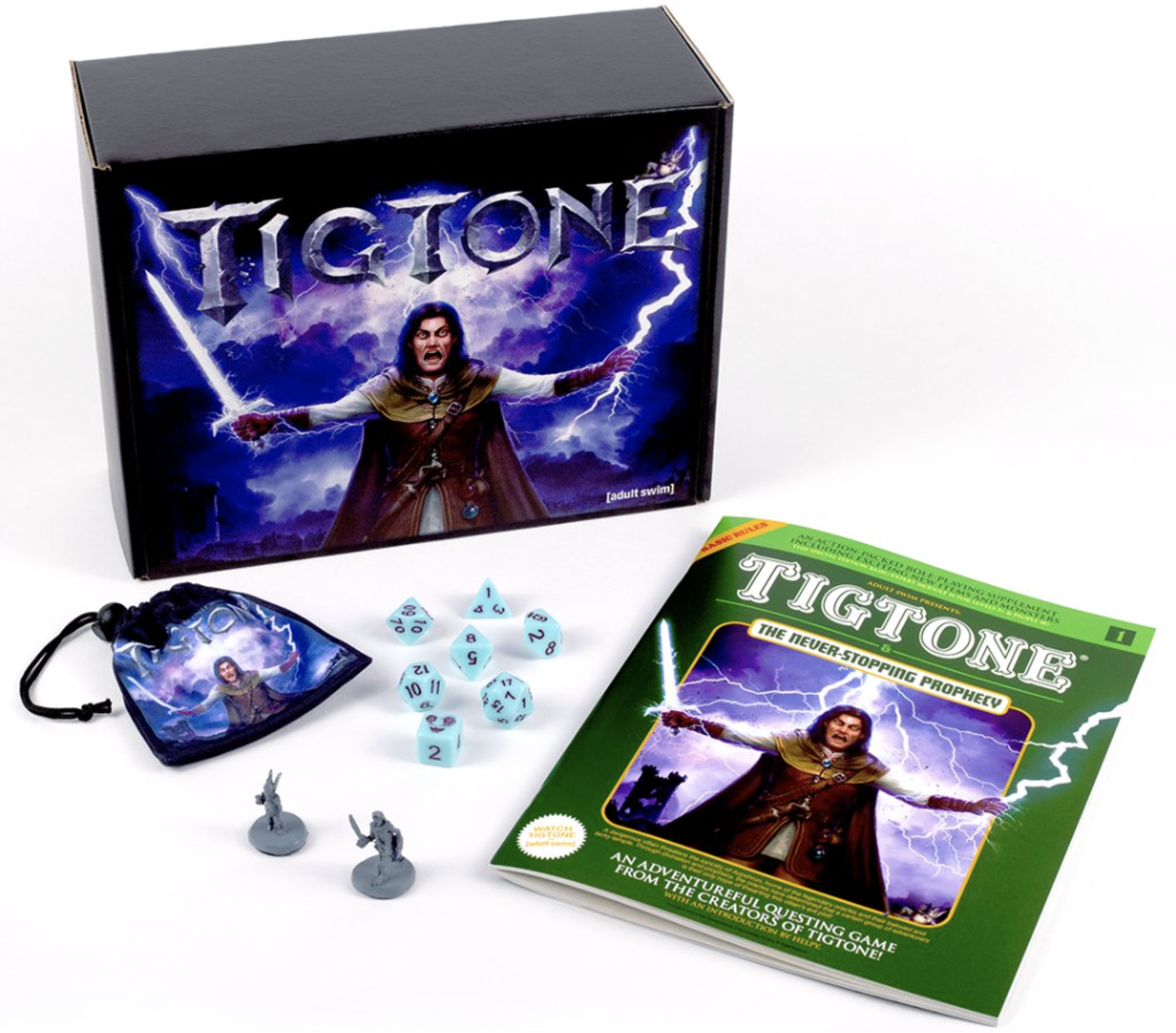
My contributions on the project included:
Developing the concept for & writing the entire adventure, inspired by the plots & locations of Tigtone
Writing sections of the supplement in the voices of characters from the show
Adapting existing items and characters to the D&D game system
Creating original characters that fit within the world of Tigtone
Hiring an editor (Adam Hancock) onto the project
Advising on layout to ensure the project resembled official D&D publications

Fey Carnival (TTRPG Location Design)
I was hired by Lion Forge Comics to write a D&D article for the April 2019 issue of the RPG/comic magazine Rolled & Told.
For: Lion Forge Comics; Rolled & Told #8 - Sites & Settings Feature
Type: Location | Worldbuilding
Genre: Fantasy
Roles: Writer | Designer
I was hired by Lion Forge Comics to create an original location suitable for games of Dungeons & Dragons, and present it in an article as the Sites and Settings feature of the April 2019 issue of their RPG/comics magazine Rolled & Told.
I wrote a piece called “The Adventure Comes to You” for which I created a traveling Fey-themed traveling carnival titled Tuatha’s Traveling Feyre and created a location, interesting characters, and unique items for Dungeon Masters to flexibly drop in to any of their adventures.
My goal with this design was to create a location that was:
Flexible enough to work in a large variety of locations
Able to be succinctly presented within the page count
Fun & interesting enough to justify its actual use in games
Flexibility — Most locations are inherently static, but a traveling carnival had all the flexibility I was looking for, while still keeping a unique identity.
Limited Scope — With only so much space to describe the carnival, anything I spent time on had to be worth the space. To that end, I dedicated a significant amount of space to the characters you might encounter at the faire as characters tend to be one of the best ways to reflect the nature of a location back to the players.
Fun & Interesting — Prep time is a challenging issue for most game masters. If the carnival was going to find its way into people’s weekly escapes it really had to pop. I felt that the fey carnival concept was already strong enough to appeal to players interested in roleplay and the sort of hijinks common to D&D. So, with my remaining space, I wanted to supplement that appeal with actual gameplay functionality.
Magic Items — It’s no secret many players are motivated by loot. I developed original magic items that were appropriate to a carnival and inspired by fey-like magic. These items were made available to players through both vendors and as prizes for carnival games.
Fey Realm — In D&D, players can travel across planes of reality. But finding ways to these other planes can be tricky. I decided that this Fey carnival would make for an interesting threshold between the realms, operating on each sides of the portal. This opened up many opportunities for game masters to use the “feyre” in connection to other adventures that required players to traverse into the fey realm.